
Tanzania Cashew Market Analysis by Mordor Intelligence
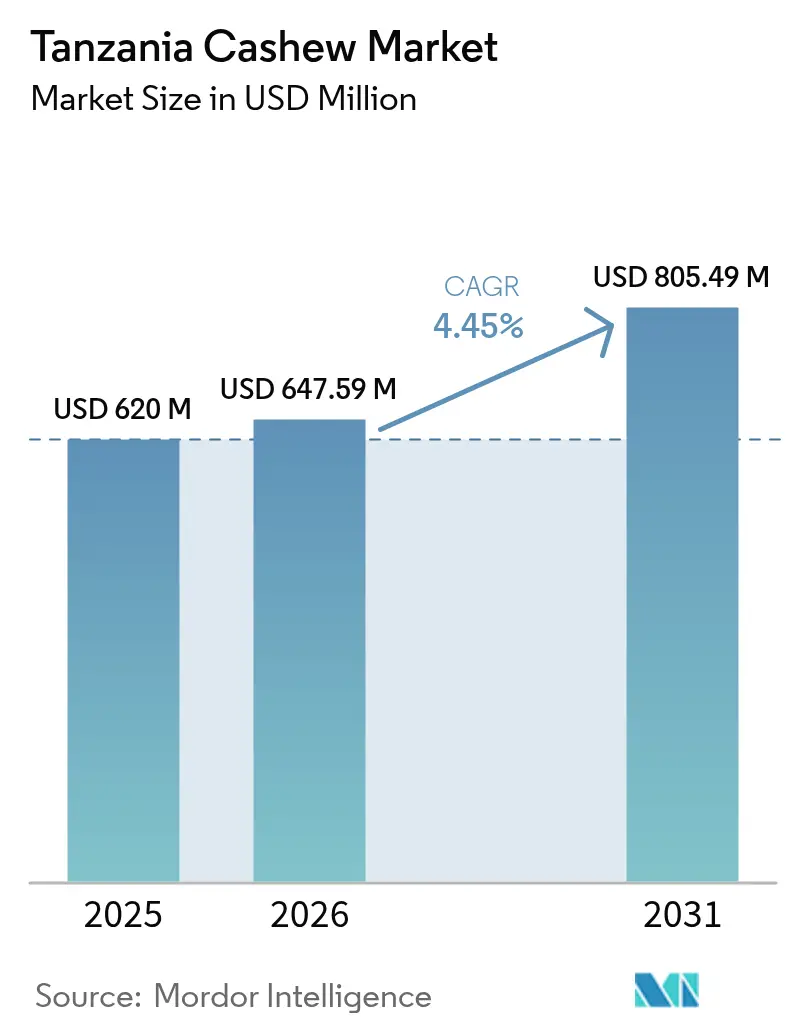
Tanzania cashew market size in 2026 is estimated at USD 647.59 million, growing from 2025 value of USD 620 million with 2031 projections showing USD 805.49 million, growing at 4.45% CAGR over 2026-2031. Rising investments in domestic processing, a transparent auction system through the Tanzania Mercantile Exchange, and sustained global demand for plant-based protein are driving this growth. Tanzania supplies nearly one-tenth of the world’s raw cashew nuts and commands a pricing premium owing to strict quality controls at farm and warehouse levels. Government reforms that let processors purchase directly from organized farmer groups have shortened the supply chain and improved raw-nut traceability. In the short term, climate-induced yield swings and raw-nut import requirements remain profit-headwinds, yet medium-term prospects are strengthened by ongoing infrastructure upgrades around the Mtwara production hub.
Key Report Takeaways
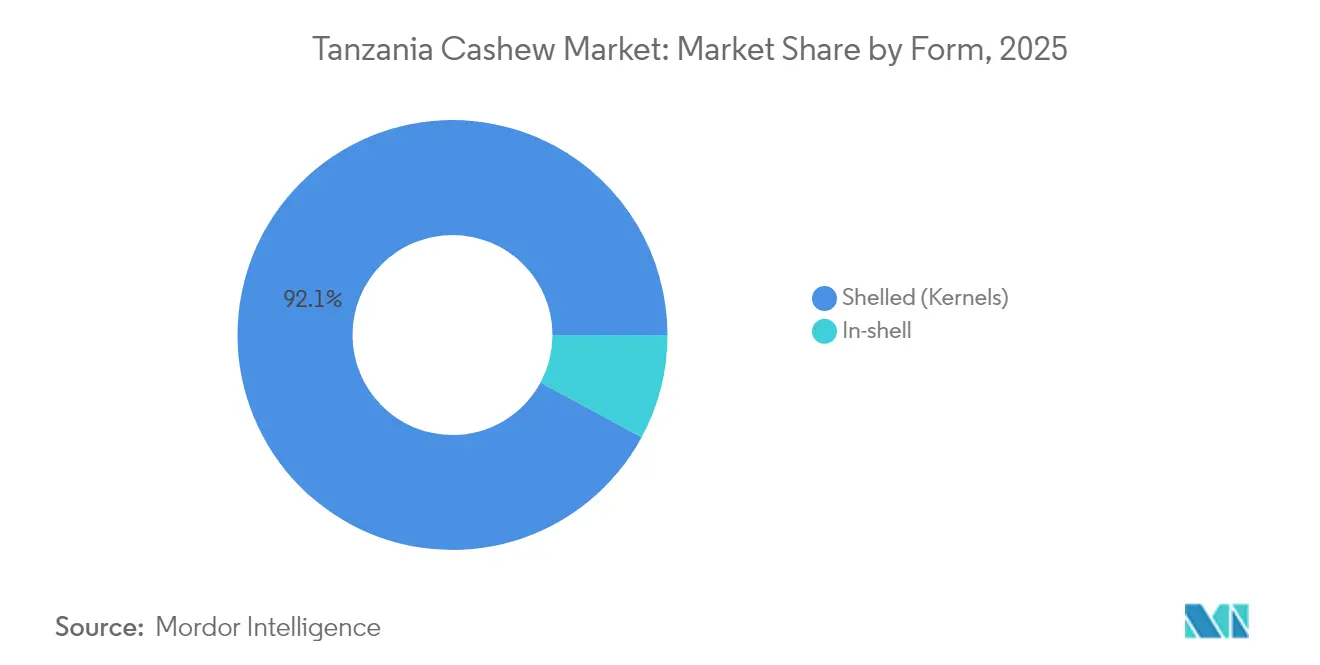
- By form, shelled (kernels) held 92.12% of the Tanzania cashew market share in 2025 and are projected to expand at a 7.35% CAGR through 2031.
Note: Market size and forecast figures in this report are generated using Mordor Intelligence’s proprietary estimation framework, updated with the latest available data and insights as of 2026.
Tanzania Cashew Market Trends and Insights
Drivers Impact Analysis*
| Driver | (~)% Impact on CAGR Forecast | Geographic Relevance | Impact Timeline |
|---|---|---|---|
| Rising demand for plant-based snacks | +1.2% | Global, with strong penetration in North America and Europe | Medium term (2-4 years) |
| Growing popularity of clean-label protein sources | +0.9% | North America, Europe, and urban Tanzania | Medium term (2-4 years) |
| Expansion of premium nut-based dairy alternatives | +0.7% | Global, led by North America and Europe | Long term (≥ 4 years) |
| Corporate wellness and healthy-vending programs | +0.5% | North America, Europe, and emerging in East Africa | Short term (≤ 2 years) |
| Fast-casual chains adding cashew-centric menu items | +0.4% | Global, concentrated in urban markets | Short term (≤ 2 years) |
| Surge in private-label gourmet trail mixes | +0.3% | North America, Europe, and Australia | Medium term (2-4 years) |
| Source: Mordor Intelligence | |||
Rising Demand for Plant-Based Snacks
Shifting dietary preferences toward plant-based foods is elevating cashew kernel consumption in nutrition bars, snack packs, and functional beverages. The Tanzania cashew market benefits because local kernels exhibit a naturally sweet flavor and favorable amino-acid profile, leading European buyers to pay double-digit premiums for traceable Tanzanian origin[1]Source: Pedro Campelo, “Nut Proteins as Plant-Based Ingredients: Emerging Ingredients for the Food Industry,” MDPI, mdpi.com. Hazard Analysis and Critical Control Point (HACCP) and Brand Reputation through Compliance Global Standard (BRCGS) standards. Scaling quality-certified capacity is essential for Tanzania to convert raw-nut exports into higher-value kernels. Tanzania's challenge lies in capturing this value through local processing rather than exporting raw nuts to Asian facilities that ultimately serve these premium markets.
Growing Popularity of Clean-Label Protein Sources
Food brands are reformulating product lines to remove artificial additives, opening space for minimally processed cashew concentrates. Organic production methods practiced in Mtwara and Lindi meet the compliance thresholds of global clean-label schemes[2]Source: ofi, “Sustainability in Cashew Farming,” ofi.com. Farmers who secure certification receive 15% price uplifts, reinforcing on-farm quality investment. This dynamic reinforces volume growth for the Tanzania cashew market as processors target premium bakery and sports-nutrition accounts. The regulatory environment supporting clean-label claims creates barriers to entry for synthetic alternatives, providing sustained competitive advantages for natural cashew-based proteins.
Expansion of Premium Nut-Based Dairy Alternatives
Cashew milk, cheese, and yogurt are gaining traction among lactose-free consumers seeking creamier textures than soy or almond milk delivers. Tanzania’s processors have begun pilot runs of ultra-filtered cashew milk destined for East African supermarket chains. Brand owners highlight the origin story to command shelf premiums, anchoring new revenue pathways for the Tanzania cashew market. Meeting strict microbiological standards, however, requires capital-intensive pasteurization lines that only a handful of domestic plants currently operate. This market development aligns with Tanzania's goal of moving beyond raw cashew exports toward higher-value processed products.
Corporate Wellness and Healthy-Vending Programs
Employers in the technology and finance sectors increasingly stock wholesome nut snacks in on-site cafeterias, adding a predictable institutional channel. Tanzanian roasted-kernel snack packs have entered pilot programs with regional airlines and business-park vendors, fetching prices 20% above commodity kernels. These deals secure steady off-take agreements that cushion processors against export-market volatility. The trend creates opportunities for Tanzanian processors to develop specialized product lines targeting institutional buyers, potentially achieving higher margins and more predictable demand than volatile export markets.
Restraints Impact Analysis*
| Restraint | (~)% Impact on CAGR Forecast | Geographic Relevance | Impact Timeline |
|---|---|---|---|
| High dependence on imported raw cashew nuts | -0.8% | Tanzania processing facilities | Short term (≤ 2 years) |
| Volatile global cashew kernel prices | -0.6% | Global, particularly affecting Tanzania's exports | Short term (≤ 2 years) |
| Supply-chain exposure to East African weather shocks | -0.5% | East Africa, with spillover effects globally | Medium term (2-4 years) |
| Competitive pressure from almond and pistachio promotional campaigns | -0.3% | Global premium nut markets | Medium term (2-4 years) |
| Source: Mordor Intelligence | |||
High Dependence on Imported Raw Cashew Nuts
Seasonal harvesting creates raw-nut gaps that force processors to import supplies from West Africa, inflating input costs and dampening margins by as much as one-fifth. Currency swings and import tariffs further strain profitability. Addressing this bottleneck is vital for the Tanzania cashew market to reach targeted 50% domestic-processing rates by 2030. The Cashew Board of Tanzania's regulatory framework requires compliance with quality standards that may limit the pool of acceptable imported raw materials, further constraining supply options.
Volatile Global Cashew Kernel Prices
Kernel prices surged 38% at Tanzania’s first Mercantile Exchange auction in 2024 following El Niño-related yield drops. Such swings complicate processor inventory planning and expose farmers to income uncertainty. Limited hedging instruments in East Africa intensify revenue risk across the Tanzania cashew market. This volatility particularly impacts smallholder farmers who lack storage facilities and must sell immediately after harvest, often at suboptimal prices that reduce their incentives to maintain or expand cashew cultivation.
*Our forecasts treat driver/restraint impacts as directional, not additive. The impact forecasts reflect baseline growth, mix effects, and variable interactions.
Segment Analysis
By Form: Processing Transformation Drives Kernel Dominance
Shelled kernels captured 92.12% of the Tanzania cashew market share in 2025, with segment value projected to grow at a 7.35% CAGR to 2031. The Tanzania cashew market size for kernels is set to expand faster than the in-shell segment because international snack brands seek ready-to-use ingredients that minimize downstream labor. Processors installing modern steaming and peeling lines now recover up to 28% more whole-kernel output, widening export premiums and improving factory break-even thresholds.
The shelled-kernel boom is encouraging factories to pursue Hazard Analysis and Critical Control Point certification so shipments can enter high-value retail channels in North America and Europe. Conversely, in-shell exports remain tied to price-sensitive buyers in India and Vietnam that prefer to conduct shelling domestically. Yet even this niche is shrinking as trade policies in importing nations increasingly reward fully processed imports. A sustained shift toward kernels, therefore, anchors medium-term revenue security for the Tanzania cashew market.



Geography Analysis
Production is heavily clustered in the southern coastal regions of Mtwara, Lindi, and Ruvuma, which together supplied over 86.74% of national output in 2025. Mtwara alone delivered 48.85% of raw nuts and hosts the country’s deepest processor density, creating scale efficiencies along the farm-to-factory corridor. The Tanzania cashew market, attributed to this region, is forecast to advance as infrastructure upgrades lower logistics costs. This geographic concentration creates logistical efficiencies for processing facilities while establishing regional expertise in cashew cultivation and post-harvest handling.
The Tanzania Mercantile Exchange, launched in Dar es Salaam in late 2024, is narrowing price gaps between rural and urban markets, raising farm-gate receipts, and improving liquidity for processors. However, poor feeder-roads and aging warehouse stock in remote districts still contribute to post-harvest losses of up to one-fifth. Government-backed warehouse-receipt systems aim to unlock credit for farmer cooperatives so they can store crops until prices peak. Local firm Micronut Tanzania has partnered with TechnoServe to roll out a digital traceability platform that links cooperative deliveries to processor purchase orders, reducing payment turnaround from one week to 48 hours.
Climate vulnerability varies across the belt: coastal zones experience salt-spray stress while inland orchards face sporadic drought. Implementation of the Cashew Act 2021 empowers regional extension officers to distribute disease-resistant seedlings and train farmers in canopy management. These interventions, alongside solar-powered irrigation pilots, are projected to stabilize yields and thus reinforce the Tanzania cashew market against weather shocks. The regulatory framework established by the Cashew Board of Tanzania provides oversight for quality standards and market operations, though enforcement capabilities vary across the geographically dispersed production areas.
Regulatory Landscape
Tanzania's cashew sub-sector is regulated by the Cashewnut Board of Tanzania (CBT), established under Act No. 18 of 2009. CBT licenses buyers, exporters, and processors, and sets and oversees quality and marketing rules. For the 2025/2026 crop season, raw cashew nut (RCN) auctions are conducted through the Tanzania Mercantile Exchange (TMX) Online Trading System (OTS) in collaboration with CBT and other market bodies, supporting standardized sales conditions, grading, and traceability at warehouse level.
Fiscal and industrial measures are also being used to accelerate domestic value addition. Under the Finance Act 2024, export levies collected on RCN from July 1, 2024 for five years are remitted to CBT to fund sector development, including farmer support inputs and services. Processing investors can also access incentives such as multi-year corporate tax exemptions, VAT relief on qualifying capital goods for Export Processing Zone (EPZ) companies, and duty-free imports for select packaging materials. CBT rules further allow licensed processors to purchase RCN directly from farmers/cooperatives outside the auction mechanism, which supports factory supply security while keeping purchases within the licensing framework.
Value Chain Analysis
The Tanzania cashew value chain begins with input supply and orchard management by a large base of smallholders (about 700,000 registered farmers), supported by extension services and targeted subsidy programs. Farmers typically aggregate through AMCOS/cooperative unions and warehouse-receipt structures before first sale, with TMX online auctions serving as the main price-discovery channel. In parallel, licensed processors can source directly from organized farmer groups under CBT rules, which helps reduce intermediaries and improve traceability.
On the downstream side, processors handle drying, shelling, peeling, grading, and packaging, then sell kernels into export and regional institutional channels. Export logistics are concentrated around the southern belt, notably the Mtwara corridor and the Port of Mtwara. Persistent constraints include low domestic processing penetration relative to production, where raw exports dominate, and seasonal raw-nut gaps that lead some plants to rely on imports to keep lines running. Government programs are targeting these pinch points through reinvestment of export-levy proceeds into inputs (for example, sulphur powder and liquid pesticides distributed in the 2024/2025 season) and through dedicated industrial infrastructure, including the planned Maranje Industrial Park in Mtwara intended to host multiple cashew mills and by-product processing units.
Market Opportunities and Future Outlook
The clearest opportunity is in scaling local processing and supporting services as Tanzania pushes policy and infrastructure toward value addition. The Maranje Industrial Park in Mtwara (1,572 acres) is positioned as a cluster for cashew factories and utilities under the Tanzania Special Economic Zones Authority framework, which gives investors a defined entry point for shelling, grading, packaging, and by-product utilization. With production reported around 617,680 tonnes in the 2025/26 season and local processing cited at roughly 8.6% as of April 2026, the processing gap supports demand for new lines, contract processing, and technology upgrades across the farm-to-factory corridor.
Upstream productivity and compliance-linked premiums also create whitespace for input suppliers, agronomy services, and traceability solutions that can be deployed through CBT-led programs and cooperative networks. In April 2026, CBT launched free input distribution for the 2026/27 season covering 549,936 farmers across key producing regions (including Mtwara, Lindi, and Ruvuma), and this coordinated rollout underpins demand for approved crop-protection products, extension tools, and data systems that connect farm practices to warehouse and processor procurement. On the market side, Tanzania's strong kernel mix (shelled kernels dominate value) aligns with buyer requirements for HACCP/BRCGS-aligned plants, supporting opportunities in certification consulting, food-safety investments, and cold-chain or quality-preserving packaging for premium export and regional retail and institutional channels.
Recent Industry Developments
- June 2026: Tanzania's Ministry of Agriculture reiterated a national push to lift annual cashew production to 1 million tonnes by 2030 while prioritizing domestic processing over raw-nut exports. The policy direction reinforces demand for new shelling and grading capacity, as well as utilities and logistics infrastructure around the southern producing hub.
- April 2026: The Cashew Board of Tanzania announced subsidized input distribution for the 2026/2027 season, covering over 500,000 farmers across key cashew regions including Mtwara, Lindi, and Ruvuma. The scale of the program supports farm-level yield and quality improvements, helping stabilize raw-nut supply for licensed buyers and processors.
- October 2024: Maersk introduced the Korosho Express ocean freight service to move cashews from the Port of Mtwara to Asian markets, operating on a bi-weekly schedule. The dedicated route strengthened export logistics from the main producing corridor and improved shipment planning for traders and processors tied to Asia-bound demand.


Research Methodology Framework and Report Scope
Market Definition and Coverage
For this study, the Tanzania cashew market is defined as the value created from cashew nuts supplied within Tanzania, captured across in-shell nuts and shelled kernels, and reflected through production, consumption, trade flows, and pricing in the country.
Scope exclusions: Cashew-based packaged foods and beverages (such as cashew milk, butter, and flavored snacks) are excluded when they are sold as processed consumer products rather than as cashew nuts.
Segmentation Overview
- By Form (Value)
- Shelled (Kernels)
- In-shell
- By Geography
- Production Analysis (Volume)
- Consumption Analysis (Volume and Value)
- Import Market Analysis (Volume and Value)
- Export Market Analysis (Volume and Value)
- Price Trend Analysis
Data Validation & Update Cycle
Validation is done in steps, where the model outputs are compared against trade values, implied unit prices, and historical season patterns to spot breaks that do not match market behavior. Any outliers are reviewed again at the assumption level, and then reconciled through a second analyst pass so the same logic is applied across years.
When a variance cannot be explained with desk signals, we go back to selected interviewees to confirm whether the change is real or caused by reporting timing, re-exports, or grading effects. Reports are refreshed annually, and interim checks are carried out when there are material events like policy shifts, unusual harvest outcomes, or visible price shocks, followed by a final pre-delivery pass to ensure clients receive the latest view.
Mordor Intelligence's Tanzania Cashew Market Estimate Compared With Other Published Estimates
Published values for the Tanzania cashew market can look far apart even when they are talking about the same country, because the counted products and the year used as the anchor are not always aligned. Differences also come from how each study treats export unit values, processed conversion, and whether price spikes are smoothed or taken as-is.
Cashew milk and cashew butter sit outside Mordor Intelligence's scope for this market, which tends to keep the total closer to the trade-and-commodity reality than estimates that fold in packaged food retail value. Other gaps usually come from mixing raw and processed prices without a clear conversion, using aggressive price escalation assumptions, or applying currency conversions from different timing windows in a volatile period.
Benchmark comparison
| Source | Market Size | Gaps in Research Methodology |
|---|---|---|
| Mordor Intelligence | USD 647.59 M (2026) | |
| Global Consultancy A | USD 425.60 M (2024) | Uses a packaged-consumer-product lens with product types like beverages and spreads, so value is influenced by retail-channel pricing and shorter historical coverage rather than trade-linked commodity flows. |
| Industry Platform B | USD 690.97 M (2024) | Anchors on a different base year and may treat export unit values as the main price reference, which can lift totals in seasons where auction and shipment realizations temporarily run hotter. |
Taken together, the spread is best explained by product coverage and the way price and conversion are handled across years. By keeping inputs tied to production, trade volumes, and observed price trends, the final number stays traceable to simple steps that can be repeated and rechecked when new season data arrives.


Key Questions Answered in the Report
How large is the Tanzania cashew market in 2026?
The Tanzania cashew market size stands at USD 647.59 million in 2026 and is forecast to reach USD 805.49 million by 2031.
What is the forecast growth rate for Tanzanian cashew sales?
Market revenue is projected to rise at a 4.45% CAGR between 2026 and 2031.
Which product form dominates Tanzanian cashew exports?
Shelled kernels accounted for 92.12% of value in 2025 and are expanding at a 7.35% CAGR, outpacing in-shell nuts.
Why do processors still import raw nuts despite domestic production?
Seasonal harvest gaps and limited storage compel processors to import West African nuts to keep factories running year-round.
How does climate change affect Tanzanian cashew yields?
Irregular rainfall linked to El Niño and La Niña can cut yields by up to one-third, prompting investment in resilient varieties and irrigation.
What recent policy supports local cashew processing?
The Cashew Act 2021 and the 2024-launched Tanzania Mercantile Exchange facilitate direct farmer-to-processor sales, improving traceability and pricing transparency.
Page last updated on:






