
Sugar Beet Market Size and Share
Sugar Beet Market Analysis by Mordor Intelligence
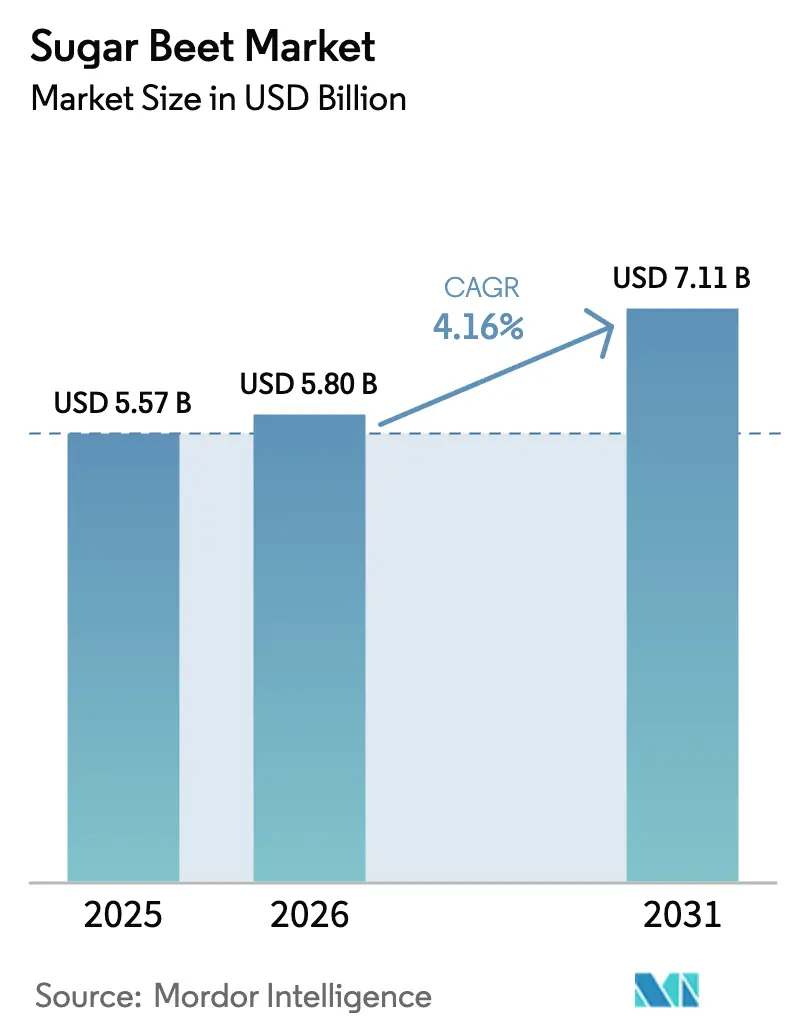
The sugarbeet market size is projected to expand from USD 5.57 billion in 2025 and USD 5.80 billion in 2026 to USD 7.11 billion by 2031, registering a CAGR of 4.16% between 2026 to 2031. The crop's resilience to demand fluctuations is attributed to its diverse end-use applications. The same production volume supports industrial sugar refining, government-mandated bioethanol blending programs, and high-fiber beet pulp for the global livestock industry. This diversification of demand helps stabilize revenues during periods of weakened sucrose prices. This structural advantage sets sugar beet apart from single-end-use commodity crops and has driven consistent capital investment in processing and seed genetics, particularly in Europe, Russia, and the growing refinery base in the Middle East. Producers and processors that leverage the crop's multi-market potential are better positioned to withstand cyclical margin pressures driven by periodic global sugar oversupply.
Key Report Takeaways
- By geography, Europe held 37% of the sugar beet market share in 2025, while Asia-Pacific is forecast to expand at a 4.3% CAGR through 2031.
Note: Market size and forecast figures in this report are generated using Mordor Intelligence’s proprietary estimation framework, updated with the latest available data and insights as of January 2026.
Global Sugar Beet Market Trends and Insights
Drivers Impact Analysis*
| Driver | (~) % Impact on CAGR Forecast | Geographic Relevance | Impact Timeline |
|---|---|---|---|
| Government biofuel blending mandates | +1.0% | Europe and North America | Medium term (2-4 years) |
| Expanding global demand for confectionery sugar | +1.0% | Global, concentrated in Asia-Pacific, Middle East and North Africa | Long term (≥ 4 years) |
| Adoption of high-yield hybrid and GMO beet seeds | +0.8% | Europe, Russia, and North America | Medium term (2-4 years) |
| Direct cultivation subsidies in the European Union | +0.5% | France, Germany, and Poland | Short term (≤ 2 years) |
| Rising use of beet pulp in high-fiber animal feed | +0.4% | Europe and North America | Long term (≥ 4 years) |
| Proliferation of micro-ethanol distilleries using beet feedstock | +0.3% | Europe especially Eastern Europe | Long term (≥ 4 years) |
| Source: Mordor Intelligence | |||
Government Biofuel Blending Mandates
Government biofuel policies are driving consistent demand for the sugar beet market, reducing its reliance on global sugar price fluctuations. Mandatory blending targets in Europe and North America ensure a baseline level of sugar beet utilization in biofuel production, even during periods of weaker refining margins. In the European Union, 3.89 million metric tons of sugar beets were used as bioethanol feedstock in 2025, with volumes projected to increase as countries advance toward renewable energy and emissions-reduction goals[2]Source: United States Department of Agriculture Foreign Agricultural Service, “Biofuel Mandates in the EU by Member State 2025,” USDA Foreign Agricultural Service, usda.gov. Germany exemplifies this trend, with beet-to-bioethanol production rising by 78.1% to 90,112 metric tons in 2024, offering greater flexibility to shift beets away from sugar production during periods of low sugar prices. Additional demand is supported by national blending mandates, such as Slovakia’s 9% bioethanol requirement and Lithuania’s 10% mandate, which expand consumption beyond the major Western European producers. The European Union’s renewable and recycled carbon fuels registry, introduced in November 2024, further strengthens established processors by enhancing their compliance infrastructure. In the United States, the Renewable Fuel Standard mandates a 2026 obligation of 26.81 billion renewable fuel credits, providing a policy foundation for ethanol demand and ensuring sustained support for beet-based biofuel production.
Expanding Global Demand for Confectionery Sugar
The Organization for Economic Co-operation and Development (OECD) - Food and Agriculture Organization (FAO) Agricultural Outlook 2025–2034 projects global sugar consumption to expand at approximately 1.2% per year, reaching 202 million metric tons by 2034, with Asia-Pacific and MENA (Middle East and North Africa) confectionery and beverage sectors contributing a disproportionate share of new demand[1]Source: Organization for Economic Co-operation and Development (OECD), "Sugar: OECD-FAO Agricultural Outlook 2025–2034," oecd.org. This demand trajectory is particularly valuable to beet sugar producers because pharmaceutical-grade and ultra-high-purity refined sucrose can be produced more consistently in beet refining than in cane-based operations, commanding price premiums in the specialty food manufacturing and pharmaceutical excipient sectors. China's total domestic sugar consumption reached 15.8 million metric tons in the 2025/26 marketing year, while domestic sugar beet production of 1.6 million metric tons covers only a fraction of this need, sustaining a structural pull on global beet-derived sugar supplies. The food processing sector's gradual shift toward natural-label sucrose, driven by consumer preference and regulatory pressure on high-fructose corn syrup alternatives in Europe and parts of North America, is redirecting procurement toward premium beet-refined sugar, adding a quality premium to otherwise volume-driven demand growth. OECD-FAO data also indicate that sub-Saharan Africa and South Asia represent medium-term swing demand markets, where urbanization and rising per capita incomes are lifting confectionery penetration rates from a low base.
Adoption of High-Yield Hybrid and GMO Beet Seeds
Seed technology is emerging as a key growth driver in the sugar beet market by improving yields without requiring proportional land expansion. KWS company has introduced varieties combining CONVISO SMART herbicide tolerance with CR+ Cercospora resistance across seven European markets for the 2025 season, addressing a disease that can reduce yields by up to 50%. Around two-thirds of global sugar beet acreage is exposed to moderate to high Cercospora leaf spot risk, underscoring the importance of these traits. Yield gains are also evident in established production regions. In the United States, Red River Valley growers supplying American Crystal Sugar improved average yields to 33.7 tons per acre in 2025, up from 32.2 metric tons per acre in 2024, reflecting advances in variety selection and agronomic practices. Russia is similarly accelerating the adoption of domestic seed, increasing its share from 67.6% of planted area in 2024 from 62.5% compared to the previous year under its seed substitution program, according to the Russian Ministry of Agriculture . Commercial traction is also strong, with KWS reporting that CONVISO SMART and CR+ traits together accounted for about 50% of sugar beet segment sales of EUR 865 million (USD 952 million) in FY2023–24. As chemical crop protection options tighten, trait-led seed innovation is becoming increasingly central to sustaining yields and stabilizing processor throughput in the sugar beet market.
Direct Cultivation Subsidies in the European Union
Direct farm support serves as a stabilizing factor for the sugarbeet market in Europe, where growers often compare beet returns with those of cereals and oilseeds before deciding on planting. Under the Common Agricultural Policy (CAP) for 2023-2027, the European Union provides Coupled Income Support for sugar beet, sugar cane, and chicory cultivation, helping to maintain planted areas in key producing countries. France and Germany collectively account for more than 33% of Europe Union's beet production in 2025, meaning even modest support payments significantly impact contracted supply and refinery utilization. This stabilizing effect was evident in the 2025-26 season when Saint Louis Sucre reduced contracted beet area by 25% for 2026-27 in France. Despite this, the overall Europe area decline remained near 8%, avoiding a sharper drop under weaker farmgate prices. Stable grower participation is critical, as beet processors operate most efficiently when contracted throughput remains consistent over extended campaigns. Without such continuity, fixed-cost absorption weakens, and processors face increased pressure to rationalize operations. For the sugarbeet market, any reduction in CAP-linked support after the 2027 review would likely impact France, Germany, and Poland first, as these countries account for a significant share of the regional beet supply.
Restraints Impact Analysis*
| Restraint | (~) % Impact on CAGR Forecast | Geographic Relevance | Impact Timeline |
|---|---|---|---|
| Competition from lower-cost sugarcane | -0.9% | Global, especially Brazil, India, Australia | Long term (≥ 4 years) |
| Volatile global sugar price cycles | -0.7% | Global | Short term (≤ 2 years) |
| Shrinking skilled farm labor in core European regions | -0.4% | Germany, France, Poland, United Kingdom | Medium term (2-4 years) |
| Stricter water-use regulations in semi-arid beet belts | -0.3% | Spain, Turkey, North Africa, western United States | Long term (≥ 4 years) |
| Source: Mordor Intelligence | |||
Competition from Lower-Cost Sugarcane
The sugar beet market continues to experience significant price pressure from lower-cost sugarcane producers, particularly Brazil, which serves as the global benchmark for sugar pricing. As a result, temperate beet processors often struggle to remain competitive. According to the OECD-FAO 2025–2034 outlook, the prospects for sugar beet are less favorable compared to sugarcane, primarily due to higher energy requirements and greater sensitivity to margins in high-cost production environments. This structural disadvantage has been further highlighted by recent market trends, where declining global sugar prices have negatively impacted the economics of beet production. For instance, Südzucker recorded an operating loss of EUR 13 million (USD 14.3 million) in its sugar segment for FY2024–25, indicating that margin pressures are widespread across the industry. In conclusion, even the most efficient European refiners face limited pricing power due to persistent global cane sugar supply. Consequently, the sugar beet market increasingly depends on efficiency improvements, co-product utilization, and policy interventions rather than price-driven growth.
Volatile Global Sugar Price Cycles
Price volatility remains a significant restraint on the sugarbeet market, as farm planting decisions are highly responsive to declines in anticipated payments. Global sugar prices are influenced by factors such as Brazilian cane production, Indian monsoon conditions, and speculative activity on ICE futures, none of which align closely with the timing of beet harvests. For instance, Tereos demonstrated the impact of such volatility when NY Sugar No. 11 futures fell from 19.60 US cents per pound in April 2025 to 15.48 cents by June 2025. In the United States, American Crystal Sugar projected net payments of USD 43.85 per metric ton for the 2025 crop, a significant decrease from USD 78 per metric ton in 2024 and USD 83.18 per metric ton in the last year, despite strong output levels. This disparity between high yields and declining returns complicates growers' ability to commit acreage beyond a single campaign. Reflecting this trend, American Crystal Sugar reduced its 2026 contracted acreage plan to 161,469. hectares from 164,707.1 hectares in 2025, highlighting the rapid response of planting intentions to weaker economic conditions. If similar reductions occur across multiple regions simultaneously, the sugarbeet market could become more vulnerable to supply fluctuations and experience more pronounced price cycles in the future.
*Our forecasts treat driver/restraint impacts as directional, not additive. The impact forecasts reflect baseline growth, mix effects, and variable interactions.
Geography Analysis
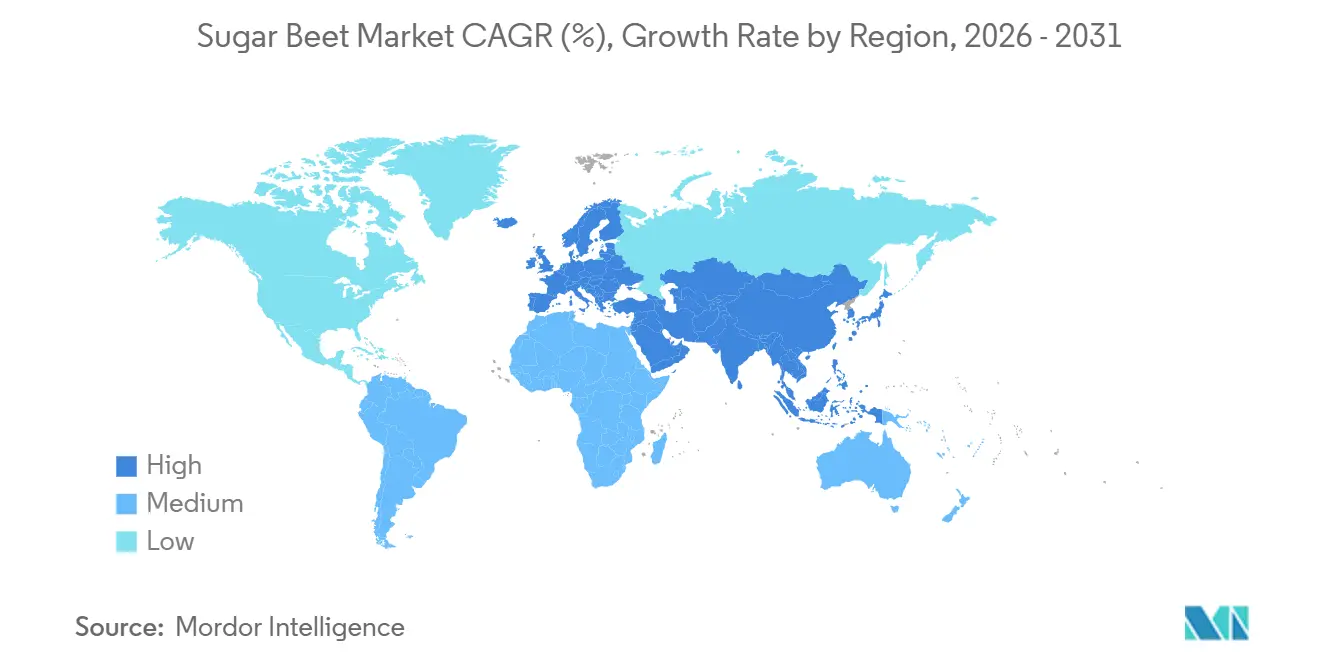
Europe's projected 37% market share in 2025 highlights the region's well-established integrated refinery and farming infrastructure. However, structural challenges are emerging across land use, pricing, and access to crop protection. European Union's sugar beet production for the 2025/26 season is forecast to decline by approximately 5% year-on-year. This decline is driven by an 8% reduction in cultivation area in France and Germany, offset only partially by modest yield improvements. Germany had an average yield of 74.8 metric tons per hectare and a sugar content of 17.2% in 2025, according to USDA. However, for the 2025/26 season, the cultivation area contracted as growers responded to lower contracted prices. Additionally, stricter water-abstraction permit reviews across Southern and Central Europe, coupled with limited chemical crop protection options, are prompting growers to invest in disease-resistant seed genetics. This approach is increasingly seen as a practical solution to sustain yields amidst environmental challenges and constraints on input availability.
Asia-Pacific is forecast to expand at a 4.3% CAGR from 2026 to 2031, making it the fastest-growing regional market for sugarbeets. China produced a significant amount of sugar beets in the 2025-26 season, keeping the country structurally dependent on imports even as local beet ambitions rise. Egypt stands out as the highest-momentum investment case in the broader region, with beet area forecast to reach 325,000 hectares in 2025-26 and Canal Sugar targeting increased refined-sugar production by 2026. Smaller African producers such as Morocco and Sudan are also expanding gradually under food security programs, while the wider Middle East remains a dependable outlet for refined beet sugar from Europe.
North America remains a significantly high-productivity region in the sugarbeet market, despite tighter acreage management. In 2025, American Crystal Sugar processed a record high of sugarbeets, with growers achieving an average yield of 33.7 tons per acre. However, the cooperative reduced its contracted acreage plan for 2026 to 399,000 acres, down from 407,000 acres in 2025, as higher yields enabled greater production on fewer acres. The United States is also experiencing a softer demand outlook for 2026, with American Crystal Sugar reporting a decline from peak demand. This decline is partly attributed to the adoption of GLP-1 drugs and reduced average food consumption. Canada is facing similar farmgate pressures, although its trade dynamics differ due to regional flows within North America.


Competitive Landscape
The sugarbeet market has a concentrated processing tier and a separate upstream seed tier that is gaining influence over value creation. In processing, Südzucker, Nordzucker, Tereos, AGRANA, and Royal Cosun remain the main names across Europe because they control large contracted beet volumes and refinery throughput. Competition is intense, but the current pattern is consolidation through site rationalization rather than large merger activity. AGRANA Beteiligungs-AG closed its Leopoldsdorf and Hrušovany sugar factories in March 2025, which showed the industry’s willingness to exit smaller or less efficient sites when returns do not justify continued operation[3]Source: AGRANA Beteiligungs-AG, “AGRANA Closes Sugar Factories in Leopoldsdorf and Hrušovany,” AGRANA, agrana.com. Nordzucker followed the same logic when it announced the closure of its Trenčianska Teplá factory in Slovakia after the 2025-26 campaign.
Decarbonization is increasingly becoming a competitive factor in the sugarbeet market as food and beverage buyers place greater emphasis on Scope 3 emissions. In December 2025, Royal Cosun signed a binding agreement with the Dutch State to invest EUR 73 million (USD 80.5 million) in electrification across three processing sites. This investment enhances its operational efficiency in energy use and emissions reduction. Tereos advanced an EUR 800 million (USD 880 million) decarbonization roadmap, validated by the Science Based Targets initiative, providing a clearer long-term strategy to meet stricter customer sustainability requirements. These developments indicate that competitive advantage in the market is being shaped not only by scale but also by the ability of processors to reduce energy intensity and mitigate compliance risks early.
Upstream, KWS maintains a strong position as proprietary seed traits gain importance due to increasing disease pressure and limited chemical control options. KWS developed seed inventory facility in Germany in 2025 and initiated construction of a new research greenhouse in Idaho in April 2025, reflecting its ongoing investment in future trait development. Concurrently, partnerships such as those with TotalEnergies and Cristal Union on beet-pulp biogas indicate that integrated processors are exploring opportunities to diversify margins beyond sugar production through energy and residue monetization.
Recent Industry Developments
- April 2026: Southern Minnesota Beet Sugar Cooperative (SMBSC) was fined USD 1.15 million by the Minnesota Pollution Control Agency for excess hydrogen sulfide emissions at its Renville, Minnesota processing facility, highlighting the environmental compliance risks that legacy North American processing sites face as air quality standards tighten. The settlement also accelerates infrastructure modernization, anticipated to strengthen the long-term resilience of the North American sugar beet market.
- February 2026: Nordzucker announced the planned closure of its Trenčianska Teplá factory in Slovakia following the conclusion of the 2025/26 beet campaign. This decision is part of the company's effort to consolidate its Central European processing network into higher-efficiency facilities and to reduce exposure in a market where contracted-beet-area economics have deteriorated. The closure is anticipated to eliminate overcapacity and shift production to higher-yielding facilities, while transitioning the site into a commercial hub to lower agricultural risk and support long-term supply chains for Central Europe.
- January 2026: Cosun Beet Company completed its 2025 processing campaign, handling 7.7 million metric tons of sugar beet and achieving a new record yield of 15.6 metric tons of sugar per hectare.


Global Sugar Beet Market Report Scope
The sugar beet (Beta vulgaris) is a cultivated root crop with high sucrose content. It is grown in temperate climates and serves as a primary source of refined white sugar, second only to sugarcane. The Sugar Beet Market Report is Segmented by Geography (North America, Europe, Asia-Pacific, and More). The Report Includes Production Analysis (Volume), Consumption Analysis (Value and Volume), Export Analysis (Value and Volume), Import Analysis (Value and Volume), Wholesale Price Trend Analysis and Forecast, A List of Key Players, Regulatory Framework, Logistics and Infrastructure, and Seasonality Analysis. The Market Forecasts are Provided in Terms of Value (USD) and Volume (Metric Tons).
| North America | United States | Production Analysis (Area Harvested, Yield, and Production Volume) |
| Consumption Analysis (Consumption Value and Volume) | ||
| Import Market Analysis (Import Value, Volume, and Key Supplying Markets) | ||
| Export Market Analysis (Export Value, Volume, and Key Destination Markets) | ||
| Wholesale Price Trend Analysis and Forecast | ||
| Regulatory Framework | ||
| List of Key Players | ||
| Logistics and Infrastructure | ||
| Seasonality Analysis | ||
| Canada | Production Analysis (Area Harvested, Yield, and Production Volume) | |
| Consumption Analysis (Consumption Value and Volume) | ||
| Import Market Analysis (Import Value, Volume, and Key Supplying Markets) | ||
| Export Market Analysis (Export Value, Volume, and Key Destination Markets) | ||
| Wholesale Price Trend Analysis and Forecast | ||
| Regulatory Framework | ||
| List of Key Players | ||
| Logistics and Infrastructure | ||
| Seasonality Analysis | ||
| South America | Brazil | Production Analysis (Area Harvested, Yield, and Production Volume) |
| Consumption Analysis (Consumption Value and Volume) | ||
| Import Market Analysis (Import Value, Volume, and Key Supplying Markets) | ||
| Export Market Analysis (Export Value, Volume, and Key Destination Markets) | ||
| Wholesale Price Trend Analysis and Forecast | ||
| Regulatory Framework | ||
| List of Key Players | ||
| Logistics and Infrastructure | ||
| Seasonality Analysis | ||
| Mexico | Production Analysis (Area Harvested, Yield, and Production Volume) | |
| Consumption Analysis (Consumption Value and Volume) | ||
| Import Market Analysis (Import Value, Volume, and Key Supplying Markets) | ||
| Export Market Analysis (Export Value, Volume, and Key Destination Markets) | ||
| Wholesale Price Trend Analysis and Forecast | ||
| Regulatory Framework | ||
| List of Key Players | ||
| Logistics and Infrastructure | ||
| Seasonality Analysis | ||
| Europe | Russia | Production Analysis (Area Harvested, Yield, and Production Volume) |
| Consumption Analysis (Consumption Value and Volume) | ||
| Import Market Analysis (Import Value, Volume, and Key Supplying Markets) | ||
| Export Market Analysis (Export Value, Volume, and Key Destination Markets) | ||
| Wholesale Price Trend Analysis and Forecast | ||
| Regulatory Framework | ||
| List of Key Players | ||
| Logistics and Infrastructure | ||
| Seasonality Analysis | ||
| France | Production Analysis (Area Harvested, Yield, and Production Volume) | |
| Consumption Analysis (Consumption Value and Volume) | ||
| Import Market Analysis (Import Value, Volume, and Key Supplying Markets) | ||
| Export Market Analysis (Export Value, Volume, and Key Destination Markets) | ||
| Wholesale Price Trend Analysis and Forecast | ||
| Regulatory Framework | ||
| List of Key Players | ||
| Logistics and Infrastructure | ||
| Seasonality Analysis | ||
| Germany | Production Analysis (Area Harvested, Yield, and Production Volume) | |
| Consumption Analysis (Consumption Value and Volume) | ||
| Import Market Analysis (Import Value, Volume, and Key Supplying Markets) | ||
| Export Market Analysis (Export Value, Volume, and Key Destination Markets) | ||
| Wholesale Price Trend Analysis and Forecast | ||
| Regulatory Framework | ||
| List of Key Players | ||
| Logistics and Infrastructure | ||
| Seasonality Analysis | ||
| Asia-Pacific | China | Production Analysis (Area Harvested, Yield, and Production Volume) |
| Consumption Analysis (Consumption Value and Volume) | ||
| Import Market Analysis (Import Value, Volume, and Key Supplying Markets) | ||
| Export Market Analysis (Export Value, Volume, and Key Destination Markets) | ||
| Wholesale Price Trend Analysis and Forecast | ||
| Regulatory Framework | ||
| List of Key Players | ||
| Logistics and Infrastructure | ||
| Seasonality Analysis | ||
| India | Production Analysis (Area Harvested, Yield, and Production Volume) | |
| Consumption Analysis (Consumption Value and Volume) | ||
| Import Market Analysis (Import Value, Volume, and Key Supplying Markets) | ||
| Export Market Analysis (Export Value, Volume, and Key Destination Markets) | ||
| Wholesale Price Trend Analysis and Forecast | ||
| Regulatory Framework | ||
| List of Key Players | ||
| Logistics and Infrastructure | ||
| Seasonality Analysis | ||
| Middle East | Turkey | Production Analysis (Area Harvested, Yield, and Production Volume) |
| Consumption Analysis (Consumption Value and Volume) | ||
| Import Market Analysis (Import Value, Volume, and Key Supplying Markets) | ||
| Export Market Analysis (Export Value, Volume, and Key Destination Markets) | ||
| Wholesale Price Trend Analysis and Forecast | ||
| Regulatory Framework | ||
| List of Key Players | ||
| Logistics and Infrastructure | ||
| Seasonality Analysis | ||
| Saudi Arabia | Production Analysis (Area Harvested, Yield, and Production Volume) | |
| Consumption Analysis (Consumption Value and Volume) | ||
| Import Market Analysis (Import Value, Volume, and Key Supplying Markets) | ||
| Export Market Analysis (Export Value, Volume, and Key Destination Markets) | ||
| Wholesale Price Trend Analysis and Forecast | ||
| Regulatory Framework | ||
| List of Key Players | ||
| Logistics and Infrastructure | ||
| Seasonality Analysis | ||
| Africa | Egypt | Production Analysis (Area Harvested, Yield, and Production Volume) |
| Consumption Analysis (Consumption Value and Volume) | ||
| Import Market Analysis (Import Value, Volume, and Key Supplying Markets) | ||
| Export Market Analysis (Export Value, Volume, and Key Destination Markets) | ||
| Wholesale Price Trend Analysis and Forecast | ||
| Regulatory Framework | ||
| List of Key Players | ||
| Logistics and Infrastructure | ||
| Seasonality Analysis | ||
| South Africa | Production Analysis (Area Harvested, Yield, and Production Volume) | |
| Consumption Analysis (Consumption Value and Volume) | ||
| Import Market Analysis (Import Value, Volume, and Key Supplying Markets) | ||
| Export Market Analysis (Export Value, Volume, and Key Destination Markets) | ||
| Wholesale Price Trend Analysis and Forecast | ||
| Regulatory Framework | ||
| List of Key Players | ||
| Logistics and Infrastructure | ||
| Seasonality Analysis | ||
| By Geography | North America | United States | Production Analysis (Area Harvested, Yield, and Production Volume) |
| Consumption Analysis (Consumption Value and Volume) | |||
| Import Market Analysis (Import Value, Volume, and Key Supplying Markets) | |||
| Export Market Analysis (Export Value, Volume, and Key Destination Markets) | |||
| Wholesale Price Trend Analysis and Forecast | |||
| Regulatory Framework | |||
| List of Key Players | |||
| Logistics and Infrastructure | |||
| Seasonality Analysis | |||
| Canada | Production Analysis (Area Harvested, Yield, and Production Volume) | ||
| Consumption Analysis (Consumption Value and Volume) | |||
| Import Market Analysis (Import Value, Volume, and Key Supplying Markets) | |||
| Export Market Analysis (Export Value, Volume, and Key Destination Markets) | |||
| Wholesale Price Trend Analysis and Forecast | |||
| Regulatory Framework | |||
| List of Key Players | |||
| Logistics and Infrastructure | |||
| Seasonality Analysis | |||
| South America | Brazil | Production Analysis (Area Harvested, Yield, and Production Volume) | |
| Consumption Analysis (Consumption Value and Volume) | |||
| Import Market Analysis (Import Value, Volume, and Key Supplying Markets) | |||
| Export Market Analysis (Export Value, Volume, and Key Destination Markets) | |||
| Wholesale Price Trend Analysis and Forecast | |||
| Regulatory Framework | |||
| List of Key Players | |||
| Logistics and Infrastructure | |||
| Seasonality Analysis | |||
| Mexico | Production Analysis (Area Harvested, Yield, and Production Volume) | ||
| Consumption Analysis (Consumption Value and Volume) | |||
| Import Market Analysis (Import Value, Volume, and Key Supplying Markets) | |||
| Export Market Analysis (Export Value, Volume, and Key Destination Markets) | |||
| Wholesale Price Trend Analysis and Forecast | |||
| Regulatory Framework | |||
| List of Key Players | |||
| Logistics and Infrastructure | |||
| Seasonality Analysis | |||
| Europe | Russia | Production Analysis (Area Harvested, Yield, and Production Volume) | |
| Consumption Analysis (Consumption Value and Volume) | |||
| Import Market Analysis (Import Value, Volume, and Key Supplying Markets) | |||
| Export Market Analysis (Export Value, Volume, and Key Destination Markets) | |||
| Wholesale Price Trend Analysis and Forecast | |||
| Regulatory Framework | |||
| List of Key Players | |||
| Logistics and Infrastructure | |||
| Seasonality Analysis | |||
| France | Production Analysis (Area Harvested, Yield, and Production Volume) | ||
| Consumption Analysis (Consumption Value and Volume) | |||
| Import Market Analysis (Import Value, Volume, and Key Supplying Markets) | |||
| Export Market Analysis (Export Value, Volume, and Key Destination Markets) | |||
| Wholesale Price Trend Analysis and Forecast | |||
| Regulatory Framework | |||
| List of Key Players | |||
| Logistics and Infrastructure | |||
| Seasonality Analysis | |||
| Germany | Production Analysis (Area Harvested, Yield, and Production Volume) | ||
| Consumption Analysis (Consumption Value and Volume) | |||
| Import Market Analysis (Import Value, Volume, and Key Supplying Markets) | |||
| Export Market Analysis (Export Value, Volume, and Key Destination Markets) | |||
| Wholesale Price Trend Analysis and Forecast | |||
| Regulatory Framework | |||
| List of Key Players | |||
| Logistics and Infrastructure | |||
| Seasonality Analysis | |||
| Asia-Pacific | China | Production Analysis (Area Harvested, Yield, and Production Volume) | |
| Consumption Analysis (Consumption Value and Volume) | |||
| Import Market Analysis (Import Value, Volume, and Key Supplying Markets) | |||
| Export Market Analysis (Export Value, Volume, and Key Destination Markets) | |||
| Wholesale Price Trend Analysis and Forecast | |||
| Regulatory Framework | |||
| List of Key Players | |||
| Logistics and Infrastructure | |||
| Seasonality Analysis | |||
| India | Production Analysis (Area Harvested, Yield, and Production Volume) | ||
| Consumption Analysis (Consumption Value and Volume) | |||
| Import Market Analysis (Import Value, Volume, and Key Supplying Markets) | |||
| Export Market Analysis (Export Value, Volume, and Key Destination Markets) | |||
| Wholesale Price Trend Analysis and Forecast | |||
| Regulatory Framework | |||
| List of Key Players | |||
| Logistics and Infrastructure | |||
| Seasonality Analysis | |||
| Middle East | Turkey | Production Analysis (Area Harvested, Yield, and Production Volume) | |
| Consumption Analysis (Consumption Value and Volume) | |||
| Import Market Analysis (Import Value, Volume, and Key Supplying Markets) | |||
| Export Market Analysis (Export Value, Volume, and Key Destination Markets) | |||
| Wholesale Price Trend Analysis and Forecast | |||
| Regulatory Framework | |||
| List of Key Players | |||
| Logistics and Infrastructure | |||
| Seasonality Analysis | |||
| Saudi Arabia | Production Analysis (Area Harvested, Yield, and Production Volume) | ||
| Consumption Analysis (Consumption Value and Volume) | |||
| Import Market Analysis (Import Value, Volume, and Key Supplying Markets) | |||
| Export Market Analysis (Export Value, Volume, and Key Destination Markets) | |||
| Wholesale Price Trend Analysis and Forecast | |||
| Regulatory Framework | |||
| List of Key Players | |||
| Logistics and Infrastructure | |||
| Seasonality Analysis | |||
| Africa | Egypt | Production Analysis (Area Harvested, Yield, and Production Volume) | |
| Consumption Analysis (Consumption Value and Volume) | |||
| Import Market Analysis (Import Value, Volume, and Key Supplying Markets) | |||
| Export Market Analysis (Export Value, Volume, and Key Destination Markets) | |||
| Wholesale Price Trend Analysis and Forecast | |||
| Regulatory Framework | |||
| List of Key Players | |||
| Logistics and Infrastructure | |||
| Seasonality Analysis | |||
| South Africa | Production Analysis (Area Harvested, Yield, and Production Volume) | ||
| Consumption Analysis (Consumption Value and Volume) | |||
| Import Market Analysis (Import Value, Volume, and Key Supplying Markets) | |||
| Export Market Analysis (Export Value, Volume, and Key Destination Markets) | |||
| Wholesale Price Trend Analysis and Forecast | |||
| Regulatory Framework | |||
| List of Key Players | |||
| Logistics and Infrastructure | |||
| Seasonality Analysis | |||


Key Questions Answered in the Report
What is the current size of the sugarbeet sector and where is it headed by 2031?
The sugarbeet market stands at USD 5.8 billion in 2026 and is forecast to reach USD 7.1 billion by 2031, growing at a 4.16% CAGR over 2026-2031.
Which region leads global sugar beet activity today?
Europe remains the largest regional base, holding 37% of global value in 2025 because of its dense refining network and policy support.
Which countries matter most for production and trade?
Russia leads production with 17% of global output in 2025, Germany leads exports with 44% of global trade flows, and Switzerland leads imports with 34% of global import demand.
Why is beet still attractive when sugar prices weaken?
The crop supports several end uses at once, including refined sugar, bioethanol, and beet pulp for feed, which helps processors and growers spread demand risk.
What is the main near-term challenge for growers in 2026?
Weaker farmgate returns are the main challenge, driven by lower global sugar prices and higher input costs, which have already led to acreage cuts in some regions.
What is driving the fastest future growth?
Asia-Pacific is estimated to grow fastest at 4.3% CAGR through 2031, supported by China’s Inner Mongolia corridor and Egypt’s rapid expansion in cultivation and refining.
Page last updated on:






