
Market Overview
| Study Period | 2021 - 2031 |
|---|---|
| Forecast Data Period | 2026 - 2031 |
| Base Year Market Size (2025) | USD 870 Billion |
| Market Size (2026) | USD 0.92 Billion |
| Market Size (2031) | USD 1.24 Billion |
| Growth Rate (2026 - 2031) | 6.03% CAGR |
| Market Concentration | Medium |
Major Players *Disclaimer: Major Players sorted in no particular order Image © Mordor Intelligence. Reuse requires attribution under CC BY 4.0. | |
Indonesia Seed Market Analysis by Mordor Intelligence
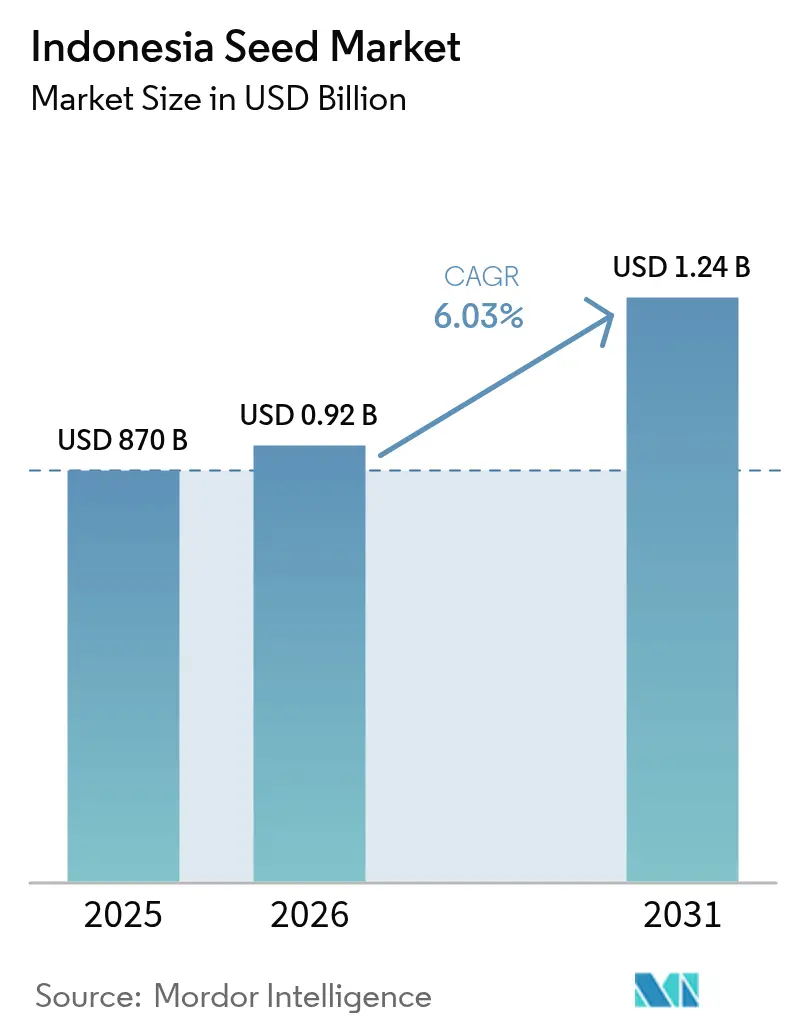
The Indonesia seed market size in 2026 is estimated at USD 922.5 million, growing from 2025 value of USD 870 million with 2031 projections showing USD 1.24 billion, growing at 6.03% CAGR over 2026-2031. Farmers are adopting certified and hybrid seed varieties to protect crop yields against weather fluctuations, soil salinity, and pest infestations. In January 2024, the Indonesian government allocated IDR 124.4 trillion (USD 7.6 billion) for seed subsidies to reduce input costs for small-scale farmers and enhance food security.[1] International Trade Administration, “Indonesia – Standards for Trade,” trade.gov Digital agriculture solutions are accelerating the transition from farmer-saved seeds to branded products with enhanced traceability. Changes in urban food consumption patterns increase demand for diverse vegetable seeds, while national rice self-sufficiency targets maintain strong demand for field crop seeds. While the market remains moderately consolidated, agricultural technology companies are transforming seed distribution through contract farming programs and mobile-based advisory services.
Key Report Takeaways
- By crop type, row crops held 67.40% of the Indonesia seed market share in 2025, whereas vegetables are expanding at a 7.12% CAGR through 2031.
- By product type, non-GM and hybrid seeds controlled 72.30% of the Indonesia seed market size in 2025, while GM seeds show the fastest 8.85% CAGR to 2031.
- The five largest producers are Charoen Pokphand Group (PT BISI International Tbk), Bayer AG, Syngenta Group, East-West Group (East-West Seed), and Corteva Agriscience captured the majority of 2024 revenue, signaling a moderately concentrated landscape.
Note: Market size and forecast figures in this report are generated using Mordor Intelligence’s proprietary estimation framework, updated with the latest available data and insights as of 2026.
Indonesia Seed Market Trends and Insights
Drivers Impact Analysis*
| Driver | (~) % Impact on CAGR Forecast | Geographic Relevance | Impact Timeline |
|---|---|---|---|
| Government Subsidy Programs for Certified Seeds | +1.2% | National, strongest in Java and Sumatra | Medium term (2–4 years) |
| Expansion of Hybrid-rice Acreage | +0.9% | Nationwide, highest in Java rice belt | Long term (≥4 years) |
| Urban Middle-class Demand for Fresh Vegetables | +0.8% | Java, Bali, and other urban hubs | Short term (≤2 years) |
| Precision Phenotyping Adoption by Local Breeders | +0.6% | Java Research and Development centers, growing in Sumatra | Long term (≥4 years) |
| Demand for Climate-resilient Varieties | +0.7% | Coastal and drought-prone zones | Medium term (2–4 years) |
| Contract-farming Seed Supply Models from Agri-tech Start-ups | +0.5% | Java, extending to outer islands | Medium term (2–4 years) |
| Source: Mordor Intelligence | |||
Government Subsidy Programs for Certified Seeds
Indonesia's food security strategy focuses on procuring certified rice seeds for extensive cultivation areas annually. The government implements price ceilings to reduce financial risks for smallholder farmers and encourage them to switch from saved seeds to certified varieties. The SNI 8211:2023 standard requires strict genetic purity standards, enabling compliant seed producers to set higher prices. While this regulatory framework reduces profit margins for informal vendors, it provides scale advantages to companies that can fulfill large institutional orders. Distributors with effective traceability systems receive faster payments and more frequent orders, which increases service standards in the Indonesian seed market.
Expansion of Hybrid-rice Acreage
Hybrid rice plays a key role in Indonesia's Upaya Khusus (UPSUS) yield-enhancement program, which aims to increase productivity compared to previous seasons. Local doubled-haploid varieties, developed specifically for tropical daylight patterns, show better performance than imported varieties. Provincial governments provide comprehensive packages including fertilizer, certified seed, and crop insurance to encourage adoption by making hybrid rice more economically feasible for farmers despite higher upfront costs. The requirement to purchase new hybrid seeds each season creates steady revenue for suppliers, supporting the growth and development of Indonesia's formal seed market.
Urban Middle-class Demand for Fresh Vegetables
Indonesia's expanding middle-income population increasingly demands nutrient-rich produce, particularly chili, tomato, and leafy greens, driving growth in the premium vegetable seed market. Seed companies like East-West Seed invest in farmer training programs to help producers meet modern retail quality standards for consistent size, flavor, and shelf life. As vegetable seeds constitute a small portion of total production costs, farmers readily invest in varieties offering enhanced disease resistance and post-harvest durability. These changing consumer preferences create stable, high-margin segments in Indonesia's vegetable seed market.
Demand for Climate-resilient Varieties
Salinity encroaches on 2.3 million coastal hectares, while drought frequency continues to rise across inland regions, intensifying the need for resilient rice varieties like Inpari 34 that tolerate 4–6 dS/m conductivity.[2]BSIP Perkebunan, “Mengatasi Tantangan Pengelolaan Perkebunan Kelapa Sawit Indonesia,” bsip.pertanian.go.id These climate-adapted seeds offer farmers a safeguard against crop failure, even under extreme conditions. Though priced at a premium, their reliability encourages adoption, especially when paired with bundled advisory services that guide optimal planting dates using rainfall forecasts. This integrated approach strengthens farmer confidence in branded genetics and contributes to the expansion of Indonesia’s seed market, aligning agricultural resilience with commercial growth in vulnerable production zones.
Restraints Impact Analysis*
| Restraint | (~) % Impact on CAGR Forecast | Geographic Relevance | Impact Timeline |
|---|---|---|---|
| Limited GM Seed Multiplication Capacity | −0.8% | Java production clusters | Long term (≥4 years) |
| Counterfeit Seed Circulation via Fragmented Channels | −1.1% | Nationwide, worst on outer islands | Short term (≤2 years) |
| Royalty-collection Uncertainty for Plant-Variety Protection | −0.4% | National | Medium term (2–4 years) |
| Coastal Soil Salinity Lowering Germination Rates | −0.6% | Java and Sumatra coasts | Long term (≥4 years) |
| Source: Mordor Intelligence | |||
Limited GM Seed Multiplication Capacity
Indonesia's biosafety review has approved only three GM crop events, with certified multiplication sites concentrated in Java.[3]U.S. Department of Agriculture, “Food and Agricultural Import Regulations and Standards,” usda.gov The lengthy approval processes for GM corn and soybean require significant working capital, which impedes market expansion. These regulatory delays increase costs, limiting smallholder farmers' access to biotech seeds and reducing market demand. The low adoption rate prevents farmers from realizing the productivity benefits of biotech traits. The Indonesian seed market's growth in genetically modified crops remains constrained by complex regulations and limited infrastructure, creating a disconnect between available technology and farmer accessibility across the country.
Counterfeit Seed Circulation via Fragmented Channels
Unauthorized traders distribute unbranded palm oil seeds through unregulated ports, affecting a significant portion of palm oil plantations and reducing yields. These unauthorized seeds reduce grower trust in established seed brands, affect royalty payments, and diminish returns on research investments. Technologies such as blockchain-based SeedChain enable seed authentication and traceability. However, the system's effectiveness requires participation from dealers and supply chain participants. The Indonesian seed market continues to face challenges from unauthorized distribution, which affects innovation and productivity in the plantation sectors.
*Our forecasts treat driver/restraint impacts as directional, not additive. The impact forecasts reflect baseline growth, mix effects, and variable interactions.
Segment Analysis
By Crop Type: Vegetables Drive Premium Growth
Row crops generated 67.40% of the Indonesia seed market size in 2025, primarily driven by extensive cultivation of rice, corn, and soybeans under government support programs. Rice cultivation covered over 8.1 million hectares, supported by guaranteed floor prices that encourage farmers to purchase certified seeds. The feed industry's annual demand of 15 million metric tons of corn maintains consistent seed demand across rain-fed and irrigated farming systems. In the soybean segment, domestic seed suppliers focus on developing higher-protein varieties to compete against imports under the USD 4.5 billion bilateral trade agreement. Groundnut cultivation remains concentrated in East Java's sandy soils, where drought-resistant varieties demonstrate superior performance compared to other legumes.
The vegetable seed segment projects a 7.12% CAGR through 2031, despite smaller cultivation areas. Chili, tomato, and leafy green crops provide quick returns for peri-urban farmers supplying supermarkets and e-commerce platforms. East-West Seed utilizes its global research and development network to develop varieties adapted to Indonesia's humid conditions, focusing on extended shelf life and reduced post-harvest losses. The development of specialty hybrids meeting export standards for Singapore and Malaysia markets commands higher prices compared to staple crops, improving overall market margins while complementing the high-volume row crop segment.




By Product Type: GM Seeds Gain Regulatory Momentum
Non-GM and hybrid categories account for 72.30% of the 2025 turnover in the Indonesia seed market share. Hybrid rice delivers higher yields through heterosis without genetic modification, meeting regulatory requirements. Vegetable hybrids combine extended shelf-life with disease resistance, driving demand in commercial farming regions. While traditional open-pollinated varieties remain prevalent in remote islands where seed recycling continues, their market share decreases as agricultural extension services promote certified seeds.
GM seeds maintain a smaller revenue share but grow at 8.85% CAGR. Presidential Regulation 45 of 2023 established enhanced biosafety protocols with defined approval timelines, providing clarity for investment planning. Field trials of Bt cotton and herbicide-tolerant corn demonstrate effectiveness, with anticipated cost reductions once local production increases. Varietal seeds, developed through conventional breeding without hybrid vigor, serve subsistence farmers seeking lower initial costs. However, their performance gap compared to hybrids and GM varieties increases annually. This performance difference motivates cooperatives and food processors to support certified seed purchases, expanding the Indonesia seed market across all technology segments.

Geography Analysis
Java dominates Indonesia seed market size due to its fertile volcanic soils, established irrigation systems, and efficient logistics networks. The region houses the main offices of major seed suppliers, facilitating rapid delivery and intensive planting schedules. Central Java's farmers demonstrate high adoption rates for new hybrid varieties, typically implementing them shortly after release. The region's proximity to urban areas enables frequent demonstration plots and training sessions, which builds consumer confidence in branded seeds and strengthens market retention.
Sumatra's seed market is expanding due to increased palm oil and food crop production, supported by improved infrastructure. The use of certified oil-palm seeds provides high germination rates and crop uniformity, reducing the risk of counterfeit varieties. The region shows increased corn and soybean cultivation, driven by feed mill operations near urban centers. Provincial research facilities collaborate with smallholder farmers in breeding programs, developing maize hybrids that ensure local adaptation and sustained usage.
The outer islands of Indonesia, Kalimantan, Sulawesi, Papua, and Maluku, offer significant potential for seed market growth. Enhanced road and port infrastructure reduces transportation time, enabling dealers to maintain stocks of improved rice and vegetable seeds. The regions' varied climate zones, from coastal to highland areas, necessitate specific breeding approaches, developed with regional university partnerships. As these regions shift from extractive industries to agriculture, formal seed distribution systems are expanding, improving access across these developing areas.
Regulatory Landscape
Indonesia's seed sector is regulated by the Ministry of Agriculture (Kementerian Pertanian) through entities such as PPVTPP for variety registration, plant variety protection, and related agricultural licensing. In October 2025, PERMENTAN No. 24 Tahun 2025 introduced a prerequirement that horticultural plant varieties must be registered before commercial dissemination, raising the compliance bar for new varietal introductions.
In February 2026, PERMENTAN No. 04 Tahun 2026 introduced a tighter framework for horticultural seed production, certification, and circulation monitoring. The regulation includes competence requirements for seed producers and quality management system certification obligations for larger-scale operators. Also in February 2026, PERMENTAN No. 05 Tahun 2026 updated the plant variety release framework (Pelepasan Varietas Tanaman) and strengthened the role of the assessment team for genetically engineered products (TPV-PRG), complementing existing Plant Variety Protection (PVT) under Law No. 29 of 2000 (exclusive rights of 20 years for annual crops and 25 years for perennials).
Competitive Landscape
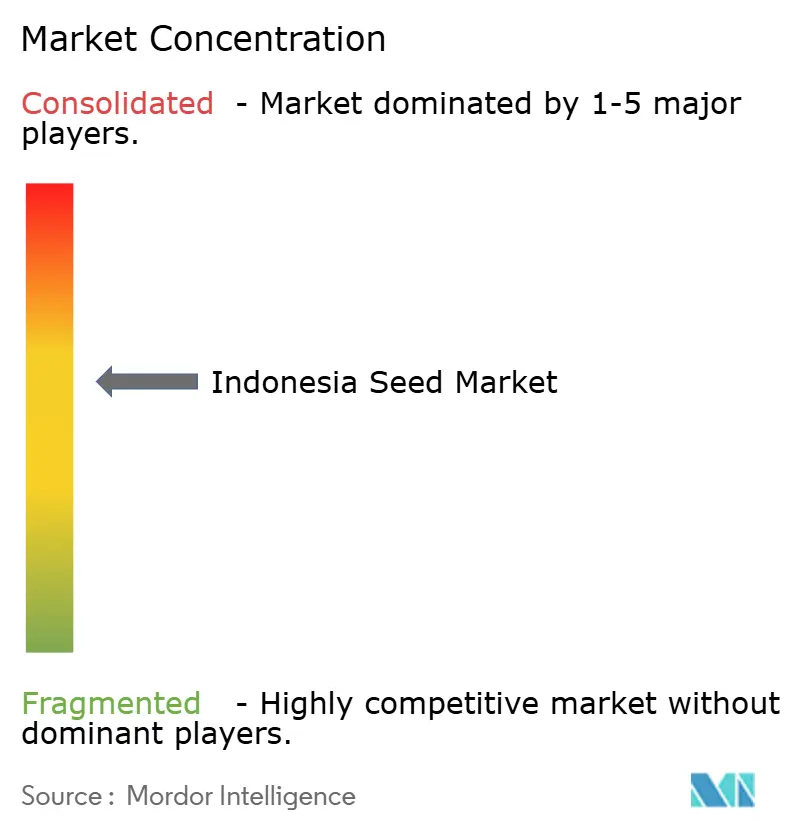
Indonesia seed market share is moderately concentrated, with leading players controlling the majority of annual revenue. Key companies include Charoen Pokphand Group (PT. BISI International Tbk), Bayer AG, Syngenta Group, East West Group (East-West Seeds), and Corteva Agriscience.. These companies combine genetics with downstream services, including feed integration, agronomic support, and premium vegetable portfolios, while adhering to domestic content regulations and GM policies. Their extensive distribution networks and farmer engagement programs build brand loyalty, particularly in high-demand crops like corn, rice, and vegetables.
Mid-tier companies are transforming market dynamics through digital solutions. Companies like Elevarm provide integrated subscription packages combining certified seed, organic inputs, and soil testing services for technology-oriented smallholders. SeedChain's blockchain initiatives improve transparency by monitoring seed transactions from breeder to planter, reducing counterfeit products. Start-ups improve distribution efficiency by establishing micro-warehouses near secondary ports, lowering last-mile delivery costs and improving access in remote areas, particularly across Indonesia's outer islands.
Public-private collaborations are becoming increasingly important, with companies such as Java Seed Indonesia, PT. Benih Citra Asia (BCA) and PT Shriram Seed Indonesia (DCM Shriram Ltd.) are collaborating with research institutes to safeguard sovereign germplasm and commercialize local discoveries. Royalty-sharing arrangements encourage commercial expansion and fund future trait development. As environmental challenges increase, companies that combine genetics, agronomy, and financial technology services, including Known-You Seed Co., Ltd, Bejo Zaden B.V., and Sakata Seed Corporation, are positioned to transform competition, moving the market from commodity-based sales toward value-based solutions.
Indonesia Seed Industry Leaders
Charoen Pokphand Group (PT BISI International Tbk)
Bayer AG
Syngenta Group
East-West Group (East-West Seed)
Corteva Agriscience
- *Disclaimer: Major Players sorted in no particular order

Market Opportunities and Future Outlook
Government-funded seed distribution and certification tightening in Indonesia are sharpening demand signals and accelerating shifts toward the formal market. In June 2026, the Ministry of Agriculture announced a multi-year (2025 to 2027) Rp 9.95 trillion program to provide free seeds for 870,000 hectares of plantation land (including coffee, cocoa, sugarcane, coconut, cashew, and spices). For suppliers, this creates structured procurement channels that prioritize specifications, logistics, and traceability.
In horticulture, PERMENTAN No. 04 Tahun 2026 calls for stricter certification and sets a two-year window for large producers to obtain quality management system certification. That change creates room for compliant players to scale branded vegetable seed portfolios and to professionalize dealer networks in secondary cities and outer-island routes. Biotech and specialty-seed opportunities remain tied to policy pathways and capability building, with Indonesia maintaining a 2020 to 2045 roadmap for genetically engineered seed development for priority crops such as rice, corn, sugarcane, and potato. GM commercialization continues to be gated by approvals and domestic multiplication capacity, while import facilitation through Ministry of Finance Regulation (PMK) 41 of 2024, which supports duty exemptions for certain seed imports used in industrial agricultural development, provides an operating route for companies bridging near-term supply gaps while investing in local multiplication and stewardship systems. Public-private coordination is also being reinforced through Universitas Gadjah Mada's Indonesia Seed Industry Leadership Forum (ISILF) 2026, which focuses on talent, technology adoption, and collaboration needs aligned with partnerships among seed companies, universities, and government research bodies.
Recent Industry Developments
- June 2026: Bayer exported 30 tons of biotech maize seeds (DEKALB DK95R) from Pasuruan, East Java, to Vietnam. The shipment indicates Indonesia's growing role as a manufacturing and distribution base for higher-technology seeds in Southeast Asia, and it increases expectations for local quality systems, stewardship, and documentation across the corn seed supply chain.
- July 2025: Syngenta expanded NK Perkasa Sakti hybrid maize seeds distribution to multiple provinces across Java and Sumatra. The push broadens reach for drought-resilient trait packages and supports branded seed adoption in larger markets.
- February 2024: Syngenta Group introduced NK Pendekar Sakti in Indonesia, described as a biotechnology corn seed with resistance to glyphosate and stem borer. The launch broadened access to traited corn options through the formal channel and reinforced how major multinationals shape adoption of biotech packages alongside agronomic programs.


Research Methodology Framework and Report Scope
Market Definition and Coverage
For this methodology, the Indonesia seed sector is defined as the value of crop seeds sold for planting within Indonesia, covering commercial seeds used across major row crops and vegetables.
Scope exclusions: Farm-saved seed reuse and on-farm grain kept back for next-season planting are excluded wherever a clear commercial transaction is not evidenced.
Segmentation Overview
- By Crop Type
- Row Crops
- Rice
- Maize
- Soybean
- Groundnut
- Other Row Crops
- Vegetables
- Chilli
- Onion
- Cabbage
- Tomato
- Other Vegetables
- Row Crops
- By Product Type
- Non-GM/Hybrid Seeds
- GM Seeds
- Varietal Seeds
Data Validation & Update Cycle
Outputs were validated through multiple checks, including comparing implied seed volumes against agronomic norms and testing whether price and mix assumptions create unrealistic year-to-year jumps. When a variance was flagged, we re-checked source dates, unit conversions, and whether a crop or seed type was being double counted, and then re-contacted experts if the gap remained material. A second analyst review is completed before sign-off so key assumptions, including adoption and pricing, remain consistent across crops and years.
Reports are refreshed annually, and interim updates are made when a material event is observed, such as a policy change, a major supply disruption, or a sharp shift in planted area. Before delivery, a fresh review pass is done so clients receive the latest market view based on the newest available public statistics and field feedback.
Mordor Intelligence's Seed Sector Analysis Indonesia Market Estimate Compared With Other Published Estimates
Published values for Indonesia seeds often differ because the scope line is drawn differently, and because the same crop demand can be translated into value using different adoption and price logic. Differences also show up when one estimate emphasizes commercial channels, while another blends in saved seed or treats crop coverage in a broader way.
In this study, gaps are usually driven by whether GM and varietal seeds are included together or separated, how hybrid penetration is treated for key crops, and how prices are converted across seasons and currency timing. The table also reflects that some sources project using a longer horizon with lower adoption lift, while others assume faster formalization of certified seeds and stronger price realization, which changes the near-term base year outcome applied by Mordor Intelligence.
Benchmark comparison
| Source | Market Size | Gaps in Research Methodology |
|---|---|---|
| Mordor Intelligence | USD 0.92 B (2026) | |
| Global Research Publisher A | USD 0.75 B (2025) | Uses a different base year and applies a lower growth path, and its scope presentation suggests broader inclusion choices like saved versus commercial availability splits that can reduce comparability to a strictly commercial demand build. |
| Market Advisory B | USD 0.91 B (2034) | Reports a longer-dated endpoint with modest CAGR, which can compress the implied near-term market when back-cast, and may apply different crop and trait coverage and a less season-sensitive price progression approach. |
Across the three figures, the spread mainly comes from year selection and how adoption and pricing are translated from crop area into a value number. When crop-wise planted area, seeding rates, and commercial adoption are kept consistent, the remaining difference tends to come from whether saved seed is blended in and how hybrid and GM pricing is handled across seasons.


Key Questions Answered in the Report
How large is the Indonesia seed market in 2026?
The Indonesia seed market size is USD 922.5 million in 2026 and will rise to USD 1.24 billion by 2031.
What is the projected growth rate for certified vegetable seed in Indonesia?
Vegetable seed revenue is advancing at a 7.12% CAGR through 2031 owing to urban demand and export opportunities.
Why are hybrid rice seeds important to Indonesia?
Hybrids support national yield targets by adding roughly 3 metric tons per hectare, and acreage under hybrid varieties is expanding by 40% from 2024 levels.
What restraints could slow Indonesian GM seed adoption?
Limited domestic multiplication capacity and lengthy biosafety approvals reduce supply and elevate costs, damping widespread uptake.
Page last updated on:






