
Non-Alcoholic Wine Market Size and Share
Market Overview
| Study Period | 2021 - 2031 |
|---|---|
| Market Size (2026) | USD 1.76 Billion |
| Market Size (2031) | USD 2.85 Billion |
| Growth Rate (2026 - 2031) | 9.12% CAGR |
| Fastest Growing Market | Asia-Pacific |
| Largest Market | Europe |
| Market Concentration | Medium |
Major Players *Disclaimer: Major Players sorted in no particular order Image © Mordor Intelligence. Reuse requires attribution under CC BY 4.0. | |
Non-Alcoholic Wine Market Analysis by Mordor Intelligence
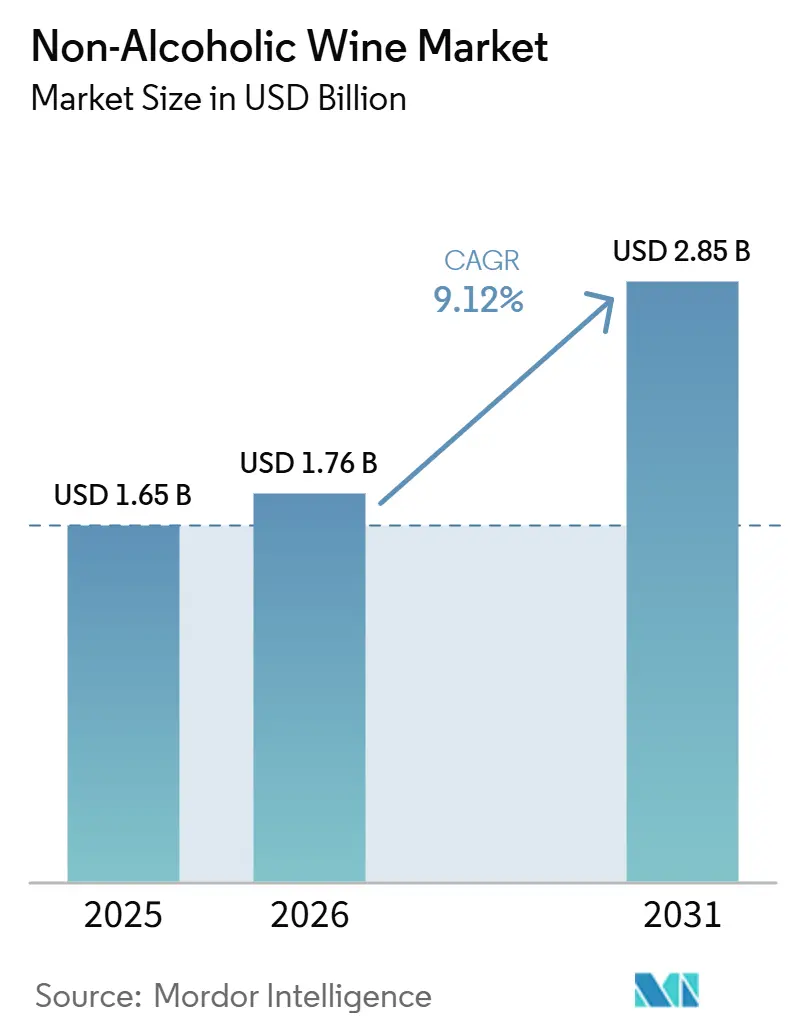
The Non-alcoholic wine market size is projected to expand from USD 1.65 billion in 2025 and USD 1.76 billion in 2026 to USD 2.85 billion by 2031, registering a CAGR of 9.12% between 2026 to 2031. The non-alcoholic wine market is benefiting from mindful drinking, changing social norms, and broader availability in retail and hospitality settings. Declining conventional wine volumes in the United States make alcohol-free products more relevant to producers that need new occasions and younger buyers. Premium sparkling products are helping consumers view the category as suitable for celebrations, meals, and gifting rather than as a substitute for soda. Producers with recognized brands, reliable sensory quality, and access to retail distribution can convert first-time purchases into repeat demand. Technology investment also matters because improved flavor retention can support premium pricing and reduce the quality gap with conventional wine.
Key Report Takeaways
- By product type, still wine held 76.28% of the non-alcoholic wine market share in 2025, while sparkling wine is forecast to grow at a 10.72% CAGR through 2031.
- By packaging type, PET and glass bottles accounted for 45.32% of the non-alcoholic wine market size in 2025, while cans are projected to advance at a 10.55% CAGR through 2031.
- By distribution channel, off-trade held 65.48% of the non-alcoholic wine market share in 2025, while on-trade is forecast to expand at a 10.85% CAGR through 2031.
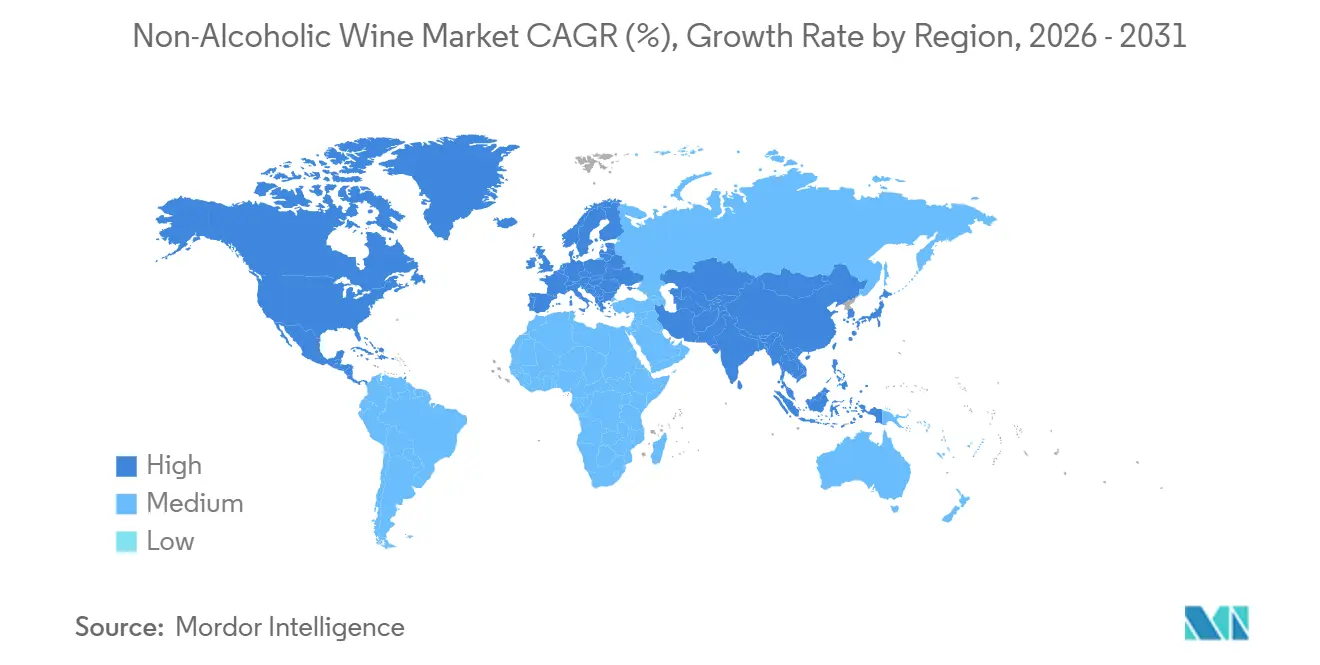
- By geography, Europe held 41.28% of the non-alcoholic wine market share in 2025, while Asia-Pacific is forecast to expand at a 11.05% CAGR through 2031.
Note: Market size and forecast figures in this report are generated using Mordor Intelligence’s proprietary estimation framework, updated with the latest available data and insights as of January 2026.
Global Non-Alcoholic Wine Market Trends and Insights
Drivers Impact Analysis*
| Driver | (~) % Impact on CAGR Forecasts | Geographic Relevance | Impact Timeline |
|---|---|---|---|
| Rising Popularity of the Sober-Curious Movement | +2.1% | Global, with strongest signals in North America and Northern Europe | Short term (≤ 2 years) |
| Increasing Demand for Premium Alcohol-Free Beverages | +1.9% | Europe (Germany, UK, France), North America | Medium term (2–4 years) |
| Advancements in Dealcoholization Technologies | +1.6% | Global, technology leadership concentrated in Europe and Australasia | Long term (≥ 4 years) |
| Growing Acceptance of Non-Alcoholic Beverages Among Younger Consumers | +1.3% | North America, Western Europe, Australia; early-stage in APAC | Medium term (2–4 years) |
| Increasing Demand from Hospitality and Foodservice Sectors | +1.1% | North America & EU, with spillover to APAC premium hospitality | Short term (≤ 2 years) |
| Growing Consumer Preference for Low-Calorie and Functional Beverages | +0.8% | Global, strongest in health-conscious APAC urban markets and North America | Long term (≥ 4 years) |
| Source: Mordor Intelligence | |||
Rising Popularity of the Sober-Curious Movement
The sober-curious movement has progressed from a seasonal abstinence practice into a year-round behavioral norm, driven by wellness priorities, social acceptance, and discretionary lifestyle management. Circana’s 2025 survey reported that 58% of U.S. consumers planned to try a non-alcoholic drink that year, with Gen Z (38%) and Millennials (37%) showing the strongest stated intent[1]Source: Circana, “Sober Curious Nation and Beverage Trends Alcohol Statistics 2025,” Circana, circana.com. A Heineken-commissioned 2025 survey across five countries found that 81% of respondents viewed declining alcohol without explanation as acceptable. This shift reflects a social-norm tipping point and addresses one of the category’s most persistent soft barriers, particularly in on-premise and corporate settings. Category demand is also moving beyond Dry January-driven spikes toward year-round consumption. Sustained growth through Dry July and Sober October campaigns is materially smoothing the seasonal revenue distribution for producers.
Increasing Demand for Premium Alcohol-Free Beverages
Premium positioning has surpassed volume expansion as the main growth driver for non-alcoholic wine, with luxury brand participation reshaping consumer expectations around pricing. In October 2024, LVMH's Moët Hennessy acquired a minority stake in French Bloom SAS, bringing prestige-house credibility to the category and supporting the broader adoption of alcohol-free sparkling wine in fine dining. The MICHELIN Guide's 2025 trend forecast highlights non-alcoholic beverage pairings as a key development influencing fine dining globally, reinforcing the investment case for producers priced above the USD 15-per-bottle threshold. Brand heritage also plays a significant role as a trial accelerator. According to a June 2026 statement cited from Freixenet Mionetto USA's CEO, consumers show a much higher willingness to try non-alcoholic options from brands they already trust. This dynamic gives established wine houses a strong competitive advantage in the premium segment, an edge that native non-alcoholic brands often lack. As a result, legacy wine producers can build meaningful share in the premium non-alcoholic tier faster than the typical timeline required for greenfield brand development.
Advancements in Dealcoholization Technologies
Spinning cone column (SCC) and membrane-based reverse osmosis technologies are reducing the flavor gap that has historically positioned non-alcoholic wine as a sensory compromise. In 2024, Schloss Wachenheim AG commissioned a second SCC-equipped dealcoholization plant at its Trier site, increasing its total dealcoholization capacity to 30 million liters per year. The company expects approximately 10 million liters of free capacity to be available in 2026 for third-party production or new market entry (Schloss Wachenheim AG investor presentation, 2025). Giesen Group’s proprietary SCC deployment, which supports production of its 0% portfolio projected to exceed 1.5 million bottles in 2025, indicates that technology leadership can strengthen premium brand positioning in competitive retail markets. As equipment costs fall and operating expertise expands across the industry through licensing and contract dealcoholization services, mid-size conventional wine producers are gaining a practical route to market. Over the medium term, this development is expected to increase price competition in the mass-premium segment.
Growing Acceptance of Non-Alcoholic Beverages Among Younger Consumers
A structural demographic shift, rather than a cyclical trend, is redefining the long-term demand curve for non-alcoholic wine. Wine Market Council 2025 data indicate that 24% of Gen Z consumers and 21% of Millennials changed the type or quantity of alcohol they consumed in the prior year to improve mood, sleep, or energy[2]Source: Wine Market Council, “Consumer Research on Changes in Alcohol Type and Quantity for Mood, Sleep, and Energy,” Wine Market Council, forbes.com. In June 2026, Shanken News Daily reported that the non-alcoholic wine category is drawing consumers under 40, particularly those aged 20-30, who are moderating alcohol consumption as part of a broader lifestyle repositioning rather than in response to a single health event or resolution. A cross-cultural perspective also emerged from a January 2026 survey in Spain published by La Vanguardia, which found that 3 in 4 Spanish consumers were willing to try non-alcoholic wine, with young people and women representing the most receptive segments. Research by the University of León, published in the British Food Journal, confirmed that health motivation, youth, and gender are the three most significant predictors of non-alcoholic wine adoption in traditional wine markets. This segmentation framework has direct implications for targeted marketing strategies and SKU prioritization.
Restraints Impact Analysis*
| Restraint | (~) % Impact on CAGR Forecasts | Geographic Relevance | Impact Timeline |
|---|---|---|---|
| Taste and Flavor Perception Challenges | -1.4% | Global, most acute in France, Spain, Italy, traditional wine-drinking markets | Medium term (2–4 years) |
| Premium Pricing Compared to Conventional Soft Drinks | -1.0% | Price-sensitive markets: developing APAC, South America; also affects value-tier consumers globally | Short term (≤ 2 years) |
| Consumer Association with Traditional Wine Culture | -0.8% | Southern Europe (France, Spain, Italy); culturally embedded wine markets | Long term (≥ 4 years) |
| Shorter Shelf-Life and Storage Considerations | -0.6% | Global, especially affecting on-trade operators and export logistics | Medium term (2–4 years) |
| Source: Mordor Intelligence | |||
Taste and Flavor Perception Challenges
Residual sensory deficits remain the category’s most persistent structural constraint. Producers continue to use thermal dealcoholization methods widely because they require lower capital investment, but these methods reduce aromatic volatiles and disrupt phenolic balance in ways that experienced tasters consistently recognize. This flavor shortfall affects traditional wine markets more severely. A Moderato/Seeds consumer barometer, cited in Vitisphere for November 2025, found that while one in five French consumers drinks non-alcoholic wine, a significant share of the remaining 80% cites a mismatch with taste expectations as a barrier to trial. The capital intensity of SCC and membrane-based technologies further disadvantages smaller producers, as lower production volumes increase their per-liter costs and limit their ability to fund the quality improvements required to meet rising consumer expectations. As a result, the market is becoming more bifurcated, with quality and scale advantages increasingly concentrated among the same well-capitalized incumbents.
Premium Pricing Compared to Conventional Soft Drinks
Non-alcoholic wines face a difficult pricing challenge. They cost more than mainstream non-alcoholic beverages but often lack the consistent quality differentiation needed to justify premiums comparable to full-ABV wines from similar origins. Conventional soft drinks, juices, and sparkling waters, priced at USD 1-3 per serving, provide affordable alternatives for price-sensitive consumers who select non-alcoholic options mainly for health reasons rather than prestige. This pricing pressure is strongest in developing markets across APAC and South America, where the premium consumption culture that supports non-alcoholic wine’s value proposition remains less mature. Producers that use label heritage instead of proven sensory quality to support their pricing face greater risk as category awareness increases and consumers become more capable of evaluating products on merit.
*Our forecasts treat driver/restraint impacts as directional, not additive. The impact forecasts reflect baseline growth, mix effects, and variable interactions.
Segment Analysis
By Product Type: Still Wine Holds Volume While Sparkling Wine Adds Premium Occasions
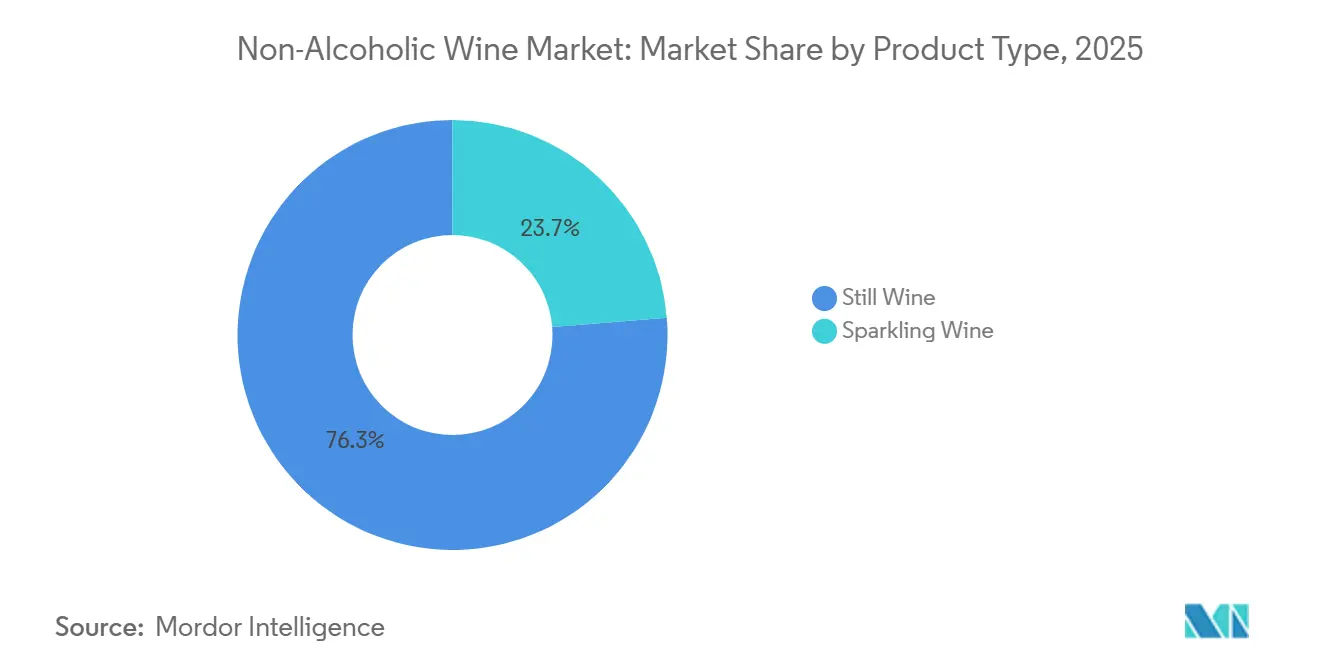
Still wine commanded 76.28% of the non-alcoholic wine market size in 2025, while sparkling wine is forecast to record a 10.72% CAGR through 2031. Still products remain the volume base because they cover everyday drinking, meal occasions, and a broad range of varietals. Their familiar format makes them a practical entry point for consumers who are reducing alcohol but still want conventional wine cues. The range also lets retailers offer several price points and flavor profiles without relying only on celebratory purchases.
Sparkling wine is growing faster because its format fits celebrations, aperitifs, and premium dining occasions. Henkell Freixenet introduced Freixenet Diamond 0.0% in April 2026 and expanded Freixenet Solare Alcohol-Free to 6 European markets in May 2026. French Bloom acquired a 25-hectare estate in Limoux in November 2025 to make alcohol-free sparkling wine from its own vineyards. These moves show that the non-alcoholic wine market has room for both broad still-wine portfolios and more specialized sparkling brands.


By Packaging Type: Bottles Maintain Quality Signals While Cans Expand Access
PET and glass bottles accounted for 45.32% of the non-alcoholic wine market share in 2025, supported by their close association with conventional wine presentation. A 750 ml bottle remains important for dining, gifting, specialty stores, and premium on-trade placement. Glass also provides familiar shelf visibility beside conventional wine. These attributes make bottles relevant for products where producers need to communicate quality before the first purchase.
Cans are forecast to grow at a 10.55% CAGR through 2031 because they suit individual serves and casual occasions. The format reduces the need to open a full bottle and is easier to use at outdoor gatherings, festivals, and informal events. Giesen launched its 0% Spritz range in 750 ml bottles in June 2025 and added slim-can 4-packs later that summer. Tetra Packs and other formats continue to serve smaller value-focused niches, but they have not yet matched the growth role of cans or the quality role of glass bottles.
By Distribution Channel: Off-Trade Leads Today While On-Trade Builds Trial
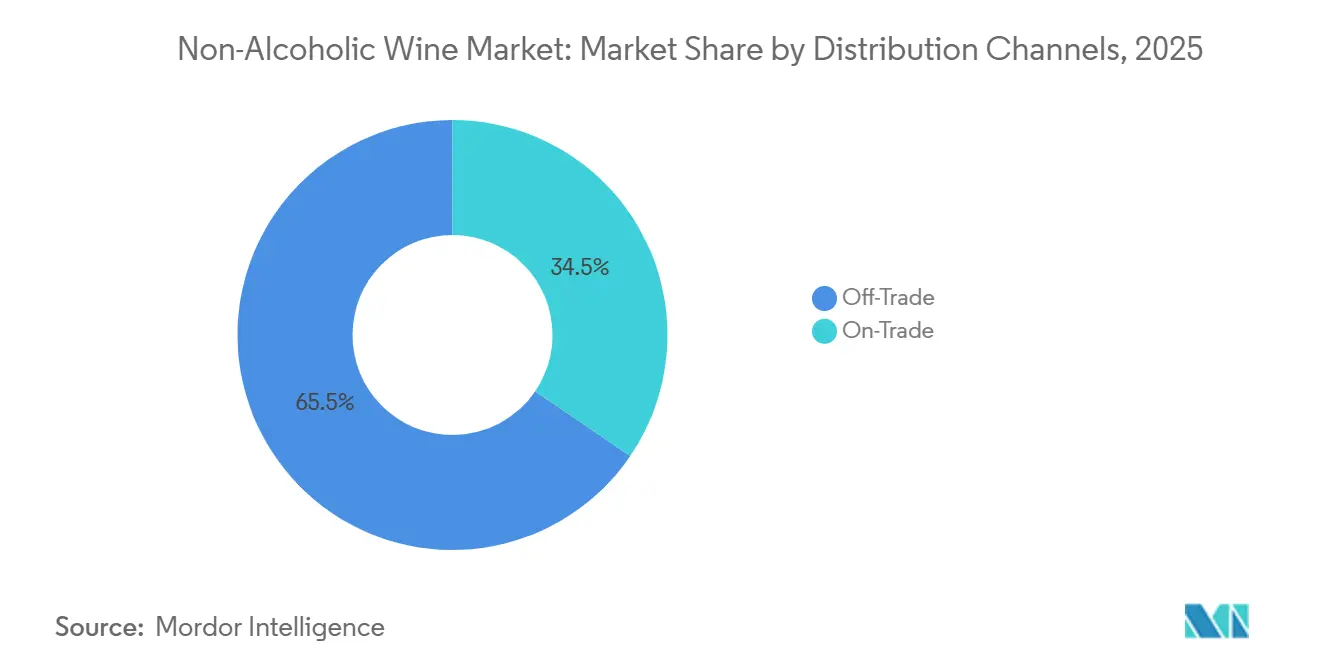
Off-trade channels held 65.48% of the non-alcoholic wine market size in 2025, with supermarkets and hypermarkets forming the main route to discovery. Grocery stores give consumers a simple way to add alcohol-free wine to normal household shopping. Specialty retailers can provide guidance where buyers are unsure about taste, grape variety, or occasion fit. Online retail adds convenience and allows consumers to compare a wider selection than a physical store may carry.
On-trade distribution is forecast to expand at a 10.85% CAGR through 2031 as restaurants and bars build more complete alcohol-free lists. Independent restaurants added 47.00% more non-alcoholic beverages to menus year over year in January 2026, and zero or low-proof categories represented 32.70% of those additions. A strong restaurant service can make an unfamiliar product easier to try because food pairing and staff advice support the experience. The non-alcoholic wine industry therefore benefits when hospitality venues treat alcohol-free choices as part of the full beverage program rather than as an occasional request.
Geography Analysis
Europe held 41.28% of the non-alcoholic wine market share in 2025, supported by technical expertise, mature retail networks, and established wine culture. Germany remained an anchor market for dealcoholized production and consumption. The German Wine Institute reported 25.00% growth in both volume and revenue for non-alcoholic wine in 2025, while household buying increased 44.00% from 2024[3]Source: German Wine Institute, “25 Pour Cent de Croissance pour les Vins Zéro en Allemagne,” German Wine Institute, magazine-fr.wein.plus. The same research found that 65.00% of purchasing households bought more than once, which indicates a growing repeat-purchase base. EU Regulation 2021/2117 recognizes dealcoholized and partially dealcoholized wine, providing a clearer labeling framework for cross-border sales.
North America is the second-largest regional market, supported by broad retail coverage, active brand marketing, and a well-developed moderation culture. U.S. non-alcoholic wine volume rose 12.00%, and value rose 16.00% year over year in May 2026, while 2025 volume reached an estimated 1.80 million cases in the supplied research. Canada adds demand through multicultural urban centers and health awareness. Mexico offers longer-term potential as premium beverage consumption expands in major cities.
Asia-Pacific is projected to be the fastest-growing region, with a 11.05% CAGR from 2026 to 2031. Health awareness, urban lifestyles, and alcohol moderation in several markets support demand for premium alternatives. China has a large urban consumer base that is increasingly open to Western-style premium beverages, while India is developing import-led availability through e-commerce. The Middle East and Africa remain smaller but offer dependable demand in markets where religious dietary norms favor alcohol-free products. The non-alcoholic wine market can benefit when producers adapt distribution and price points to local purchasing conditions instead of relying on European retail models.

Competitive Landscape
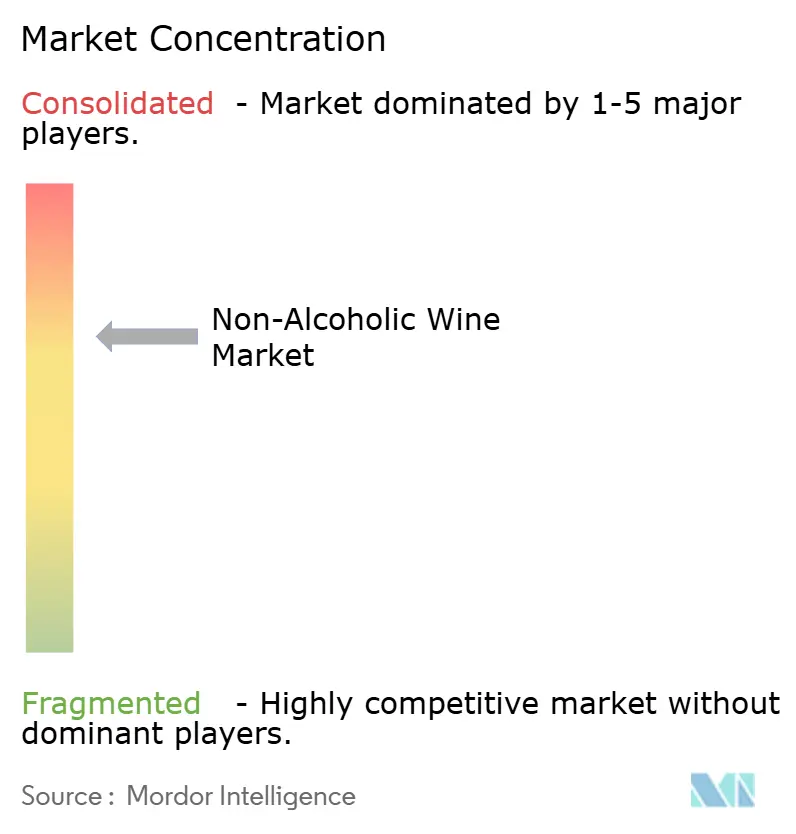
The non-alcoholic wine market is moderately consolidated because established European sparkling producers hold meaningful advantages in processing, distribution, and brand recognition, while specialist brands continue to gain traction. Henkell Freixenet reports leadership in non-alcoholic sparkling wine in more than 30 countries and recorded 23.00% growth in 2024. The company has expanded across price tiers with Henkell 0.0%, Freixenet Cordon Negro 0.0%, and Freixenet Diamond 0.0%. This approach pairs established brand recognition with a portfolio designed for entry-level, mainstream, and premium occasions.
Schloss Wachenheim follows a capacity-led strategy. Its second dealcoholization plant doubled annual capacity to 30.00 million liters, which gives the company production flexibility as demand develops. The company reported H1 fiscal 2025/26 revenue of EUR 261.20 million, equivalent to USD 272.00 million, in February 2026 and reported 44.00% growth in non-alcoholic wine sales in the prior fiscal year. In the non-alcoholic wine market, this scale can support both proprietary labels and third-party production.
Open areas remain in premium still wines beyond familiar Riesling and Sauvignon Blanc styles, direct distribution in Asia-Pacific, and functional products. O'Neill Vintners & Distillers launched FitVine Free in January 2026 with adaptogens and electrolytes, creating a functional positioning within alcohol-free wine. French Bloom and Oddbird are using direct consumer engagement and distinctive brand presentation to build awareness before wider retail listings. Compliance requirements in the United States and the EU also reward companies that can manage labeling and cross-border distribution consistently.
Non-Alcoholic Wine Industry Leaders
Australian Vintage Limited
Schloss Wachenheim AG
Giesen Group Ltd
J. Lohr Vineyards and Wines
Familia Torres
- *Disclaimer: Major Players sorted in no particular order

Recent Industry Developments
- June 2026: Aurora, a multi-brand retail chain, launched Fine Eat, its private label of non-alcoholic wine, to address rising consumer demand for alcohol-free options. Produced by Moldovan winery Imperial Vin, the Fine Eat line features semi-sweet Cabernet Sauvignon red wine and Traminer white wine. The wines go through complete winemaking processes before alcohol removal to preserve their authentic taste and aroma.
- March 2026: Butter Wines expanded into the alcohol-free beverage category with the launch of ButterZero, a new portfolio of premium alcohol-removed wines containing less than 0.5% ABV. The range includes Sparkling Rosé, Sauvignon Blanc, Chardonnay, and Pinot Noir, each offering 65 calories or fewer per glass and being gluten-free.
- January 2026: Elton John partnered with Benchmark Drinks to launch Elton John Zero Blanc de Blancs, a premium 0.0% alcohol sparkling wine crafted from 100% Chardonnay grapes sourced from northern Italy. Unlike conventional dealcoholized wines, the product is produced using an innovative fermentation process that develops wine-like flavor and texture without generating alcohol, preserving its premium sensory profile.


Global Non-Alcoholic Wine Market Report Scope
| Still Wine |
| Sparkling Wine |
| PET/Glass Bottles |
| Cans |
| Tetra Packs |
| Others |
| On-Trade | |
| Off-Trade | Supermarkets/Hypermarkets |
| Specialty Stores | |
| Online Retail Channels | |
| Other Distribution Channels |
| North America | United States |
| Canada | |
| Mexico | |
| Rest of North America | |
| Europe | Germany |
| United Kingdom | |
| France | |
| Italy | |
| Spain | |
| Netherlands | |
| Sweden | |
| Poland | |
| Belgium | |
| Rest of Europe | |
| Asia-Pacific | China |
| India | |
| Japan | |
| Australia | |
| South Korea | |
| Vietnam | |
| Indonesia | |
| Thailand | |
| Singapore | |
| Rest of Asia-Pacific | |
| South America | Brazil |
| Argentina | |
| Chile | |
| Peru | |
| Colombia | |
| Rest of South America | |
| Middle East and Africa | United Arab Emirates |
| Saudi Arabia | |
| South Africa | |
| Nigeria | |
| Egypt | |
| Morocco | |
| Turkey | |
| Rest of Middle East and Africa |
| Product Type | Still Wine | |
| Sparkling Wine | ||
| Packaging Type | PET/Glass Bottles | |
| Cans | ||
| Tetra Packs | ||
| Others | ||
| Distribution Channels | On-Trade | |
| Off-Trade | Supermarkets/Hypermarkets | |
| Specialty Stores | ||
| Online Retail Channels | ||
| Other Distribution Channels | ||
| By Geography | North America | United States |
| Canada | ||
| Mexico | ||
| Rest of North America | ||
| Europe | Germany | |
| United Kingdom | ||
| France | ||
| Italy | ||
| Spain | ||
| Netherlands | ||
| Sweden | ||
| Poland | ||
| Belgium | ||
| Rest of Europe | ||
| Asia-Pacific | China | |
| India | ||
| Japan | ||
| Australia | ||
| South Korea | ||
| Vietnam | ||
| Indonesia | ||
| Thailand | ||
| Singapore | ||
| Rest of Asia-Pacific | ||
| South America | Brazil | |
| Argentina | ||
| Chile | ||
| Peru | ||
| Colombia | ||
| Rest of South America | ||
| Middle East and Africa | United Arab Emirates | |
| Saudi Arabia | ||
| South Africa | ||
| Nigeria | ||
| Egypt | ||
| Morocco | ||
| Turkey | ||
| Rest of Middle East and Africa | ||


Key Questions Answered in the Report
What is the projected value of the non-alcoholic wine market by 2031?
The category is projected to reach USD 2.85 billion by 2031, rising from USD 1.76 billion in 2026 at a 9.12% CAGR.
Which product type is growing fastest in non-alcoholic wine?
Sparkling wine is forecast to grow at a 10.72% CAGR through 2031, supported by premium celebrations and foodservice use.
Why are cans gaining importance for alcohol-free wine brands?
Cans are forecast to grow at a 10.55% CAGR because they provide single-serve convenience for casual and outdoor occasions.
Which sales channel currently leads alcohol-free wine purchases?
Off-trade channels held 65.48% of sales in 2025, while on-trade channels are forecast to grow faster at a 10.85% CAGR.
Page last updated on:






