
Market Overview
| Study Period | 2022 - 2031 |
|---|---|
| Forecast Data Period | 2026 - 2031 |
| Base Year Market Size (2025) | USD 16.82 Billion |
| Market Size (2026) | USD 17.64 Billion |
| Market Size (2031) | USD 22.36 Billion |
| Growth Rate (2026 - 2031) | 4.86% CAGR |
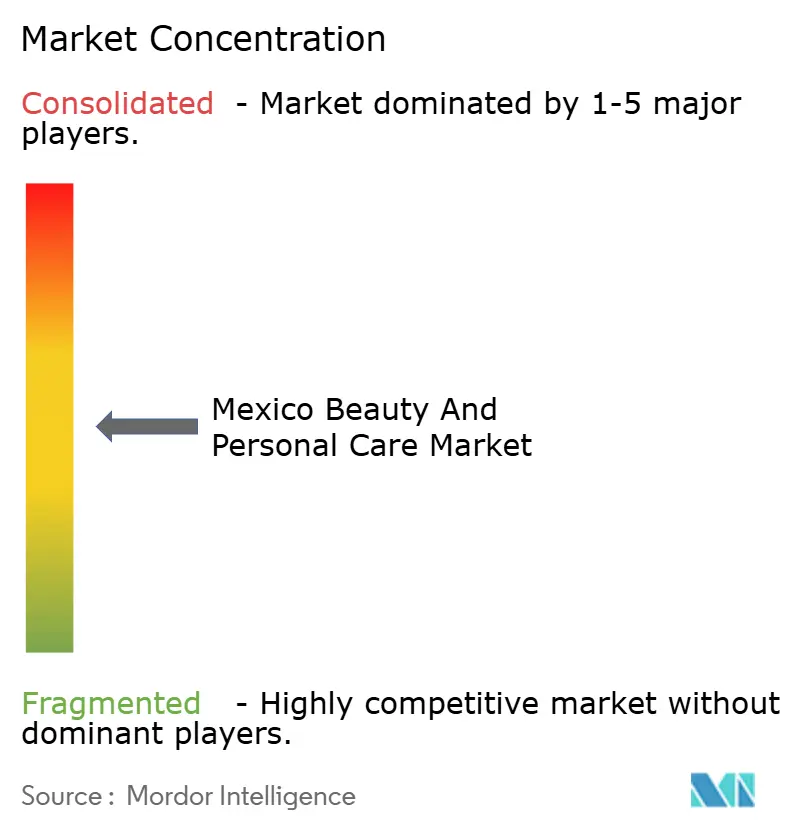
| Market Concentration | Medium |
Major Players *Disclaimer: Major Players sorted in no particular order Image © Mordor Intelligence. Reuse requires attribution under CC BY 4.0. | |
Mexico Beauty And Personal Care Market Analysis by Mordor Intelligence
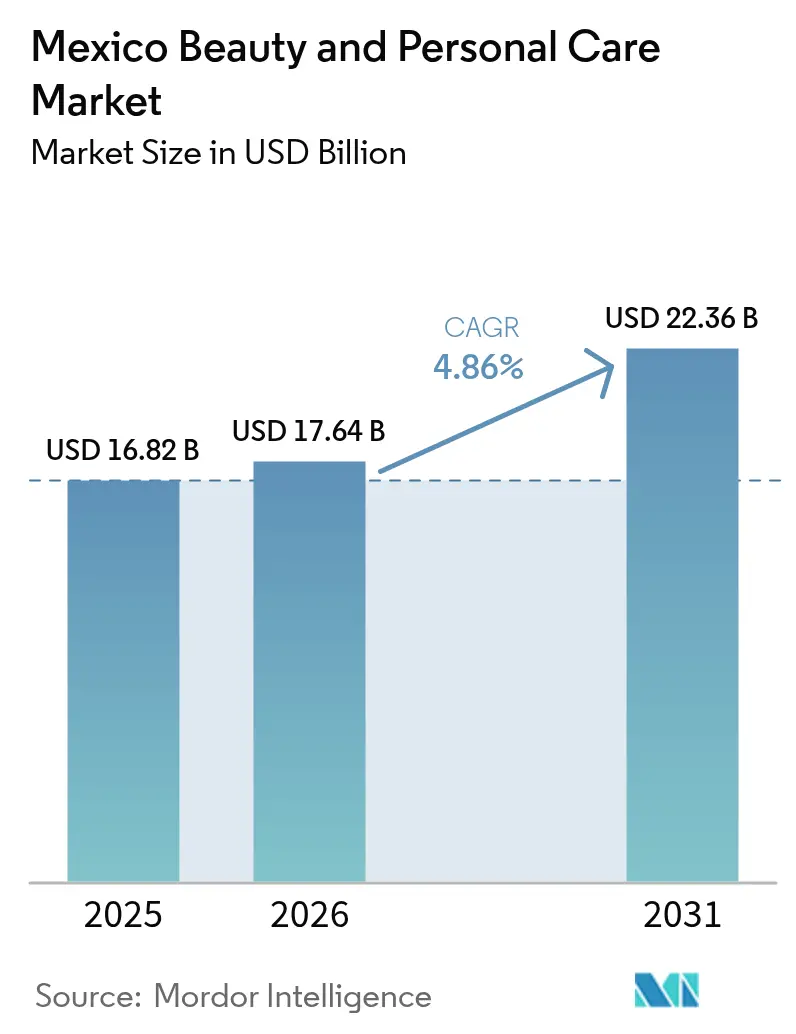
The Mexico beauty and personal care market size is expected to grow from USD 16.82 billion in 2025 to USD 17.64 billion in 2026 and is forecast to reach USD 22.36 billion by 2031 at 4.86% CAGR over 2026-2031. Demand gains stem from rising disposable incomes among urban households, Gen Z’s digital buying habits, and the near-shoring of manufacturing capacity that reinforces supply-chain resilience. Heavy foreign direct investment—up 43% in 2024—confirms Mexico’s pull as a regional production hub, while regulatory upgrades by COFEPRIS accelerate product registrations and encourage innovation. Competitive intensity remains moderate, giving both incumbents and start-ups room to capture share in men’s grooming, natural/organic formulas, and social-commerce channels. Raw-material cost swings and water scarcity are the chief margin headwinds, yet the sector’s broad product mix and strong e-commerce momentum continue to cushion risk.
Key Report Takeaways
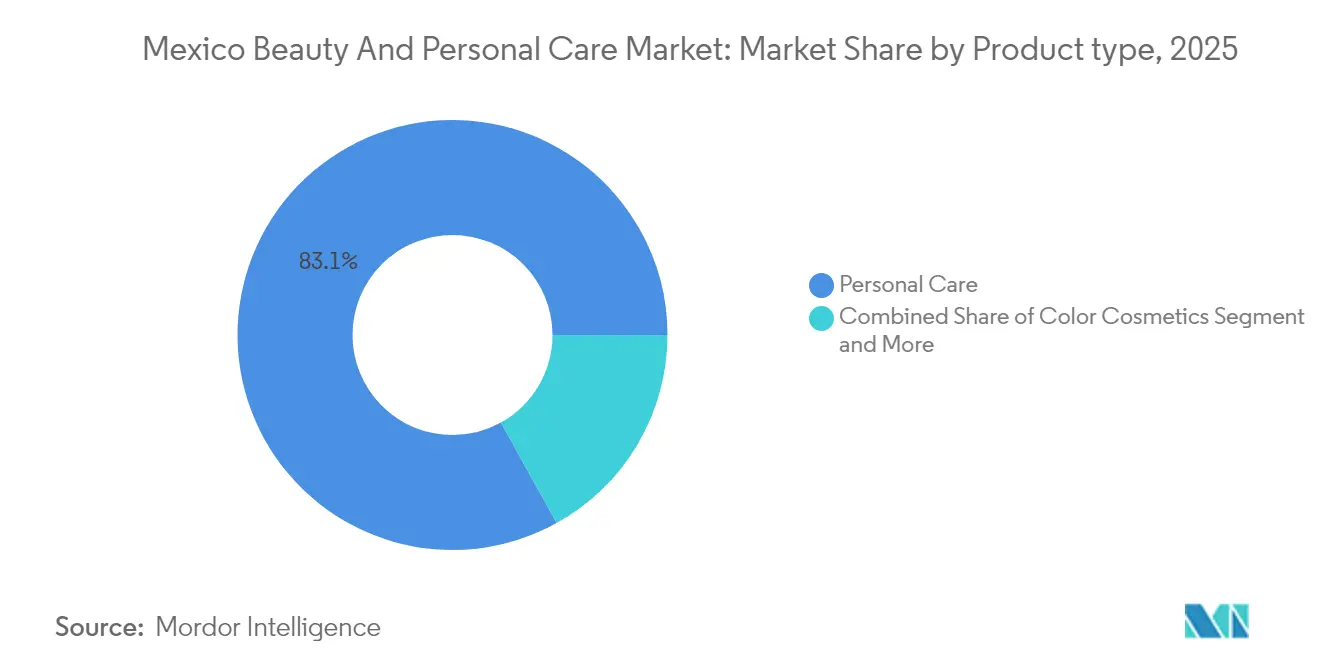
- By product type, personal care held 83.05% of the Mexico beauty and personal care market share in 2025, while the segment is expanding at a 5.03% CAGR through 2031.
- By category, mass products controlled 70.62% of sales in 2025; the premium segment is projected to rise at a 5.08% CAGR to 2031.
- By ingredient, conventional formulas retained 67.92% share in 2025, whereas natural/organic products are growing at a 5.74% CAGR to 2031.
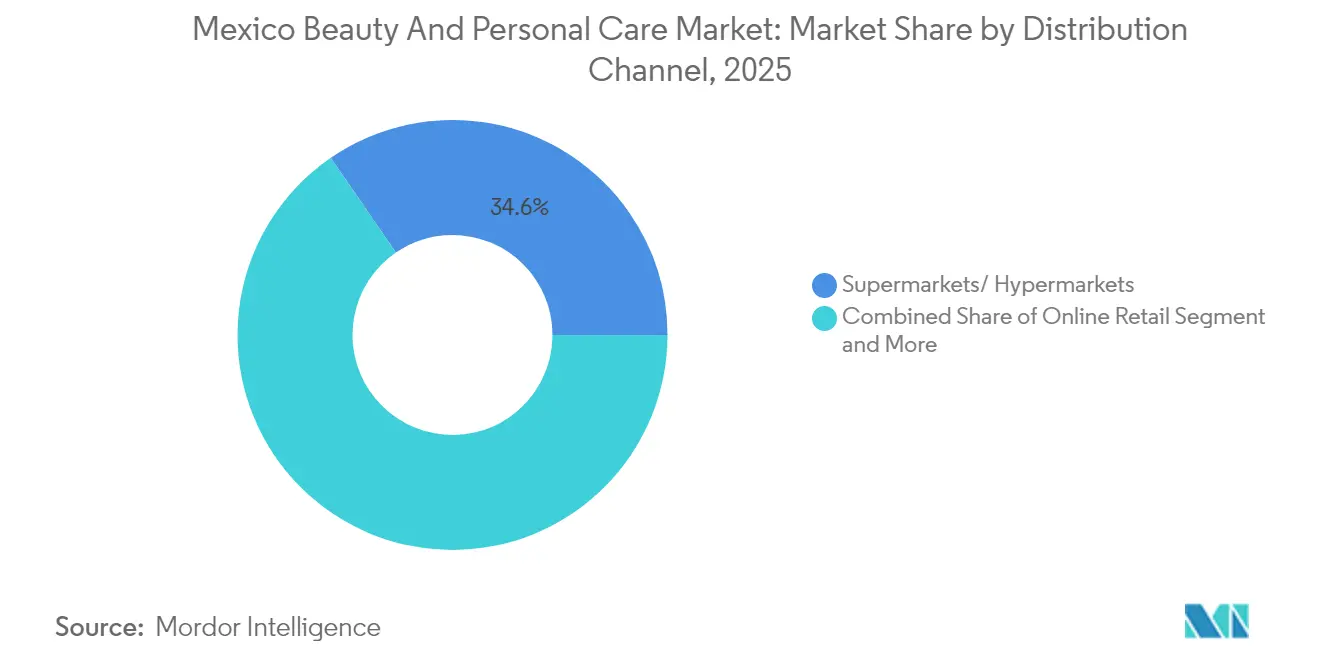
- By distribution channel, supermarkets and hypermarkets captured 34.58% of the Mexico beauty and personal care market share in 2025; online retail is on track for a 6.02% CAGR over the forecast horizon.
Note: Market size and forecast figures in this report are generated using Mordor Intelligence’s proprietary estimation framework, updated with the latest available data and insights as of 2026.
Mexico Beauty And Personal Care Market Trends and Insights
Drivers Impact Analysis*
| Driver | (≈) % Impact on CAGR Forecast | Geographic Relevance | Impact Timeline |
|---|---|---|---|
| Rising demand for natural & organic formulations | +0.8% | National — urban focus | Medium term (2-4 years) |
| E-commerce and social-commerce boom | +1.2% | National — metro acceleration | Short term (≤ 2 years) |
| Premiumization backed by higher disposable income | +0.9% | Urban & secondary cities | Medium term (2-4 years) |
| Men’s grooming adoption surge | +0.6% | Nationwide; early gains in big three cities | Long term (≥ 4 years) |
| Masstige hybrids for Gen Z | +0.7% | Digitally-native cohorts | Short term (≤ 2 years) |
| Near-shoring incentives for manufacturing | +0.5% | Northern border states | Long term (≥ 4 years) |
| Source: Mordor Intelligence | |||


Rising Demand for Natural & Organic Formulations
Natural and organic products already hold 10% value share, and 84% of consumers say they will pay for sustainable items, prompting brands to secure ECOCERT or COSMOS seals to validate claims. Domestic innovators such as Aloe Jaumave have gained COSMOS v4 certification, evidencing how local players use accreditation to win shelf space[1]ECOCERT, “ALOE JAUMAVE S.A. DE C.V.,” ecocert.com. Trade-body CANIPEC reports the number of Mexican personal-care brands has tripled since 2013, most positioning around plant-based ingredients. Still, meeting NOM-119-SSA1-1994 for natural colorants raises testing costs and lengthens time-to-market, compelling small firms to partner with contract manufacturers that already comply.
E-commerce and Social-Commerce Boom
Health and beauty e-commerce is largely gaining traction in the market, with emerging e-commerce TikTok Shop and Instagram Checkout shortening the path from product discovery to purchase, lifting repeat-order frequency among women over 35[2]Mexico Business News, “5 Indicators of Disruption in Mexico’s Health E-Commerce Sector,” mexicobusiness.news. Brick-and-click chains such as Farmacias del Ahorro have rolled out same-day delivery in 25 cities to keep share. Regulatory scrutiny is rising; COFEPRIS now issues 24-hour resolutions for certain OTC cosmetic modifications, smoothing digital assortment updates. Enhanced logistics, simplified customs rules for parcels under USD 2,500, and broader 4G coverage underpin the channel’s outsized growth.
Premiumization Backed by Higher Disposable Income
Although the average Mexican spends just USD 90 on cosmetics a year, the premium tier is growing nearly one percentage point faster than mass lines as incomes climb and retail experiences improve[3]Holland & Knight, “Reglas Generales de Comercio Exterior para 2025 en México,” hklaw.com. Department stores showcase exclusive beauty rooms and virtual-skin diagnostics that justify premium price tags. Local marques exploit peso stability and lower freight bills to undercut imported rivals without diluting luxury cues. Foreign labels, conversely, face exchange-rate swings that inflate landed costs, forcing selective price rises and smaller pack formats to preserve volume. Overall premium penetration remains modest, giving brand builders ample runway for upselling strategies.
Men’s Grooming Adoption Surge
CANIPEC identifies men’s grooming as a priority niche, citing social-media influence and shifting cultural norms that normalize male skin-care routines. Growth is particularly strong among Gen Z, whose earnings are rising and whose beauty ideals embrace self-expression. Multinationals now field beard oils, tinted moisturizers, and gender-neutral fragrances, while barbershop chains drive trial through service-product bundles. Marketing must still navigate pockets of conservatism, especially outside tier-one cities; hyper-masculine cues and functional benefit claims resonate best in these areas. As spending gaps between men and women narrow, brands with inclusive positioning stand to solidify early-mover advantage.
Restraints Impact Analysis*
| Restraint | % Impact on CAGR Forecast | Geographic Relevance | Impact Timeline |
|---|---|---|---|
| Counterfeiting & grey-market imports | -0.6% | National, concentrated in border regions | Short term (≤ 2 years) |
| Raw-material cost volatility & FX risk | -0.8% | National, affecting all manufacturers | Medium term (2-4 years) |
| 2025 cross-border customs rules for e-commerce | -0.3% | National, with higher impact on digital-first brands | Short term (≤ 2 years) |
| Water-scarcity sustainability compliance costs | -0.5% | National, concentrated in manufacturing regions | Long term (≥ 4 years) |
| Source: Mordor Intelligence | |||
Raw-Material Cost Volatility & FX Risk
Global energy inflation and freight spikes lifted input costs, squeezing formulators that rely on imported actives and packaging. The peso’s fluctuations add budgeting complexity, compelling hedging or local sourcing when feasible. Water, which accounts for 9.6% of industrial usage, is becoming costlier as 150 aquifers are already over-exploited, pushing firms toward closed-loop or recycled-water systems. Near-shoring of ingredient supply from the U.S. and Brazil alleviates some FX risk, but smaller brands still struggle to pass on price hikes, dampening expansion plans.
Counterfeiting & Grey-Market Imports
COFEPRIS issued multiple 2025 alerts covering bogus Botox lots A63631, U14534, and W18029, plus unregistered Chinese makeup, underscoring ongoing safety and brand-equity threats. PROFECO inspections flagged Amuse and L.A. Girl for missing origin labels, feeding consumer distrust and price wars in premium segments. While COFEPRIS tightened 24-hour seizures and cross-agency data sharing, the porous 3,150 km U.S.–Mexico border, plus booming cross-border e-commerce, hinder enforcement. Legitimate players offset risk by embedding track-and-trace codes and partnering with customs-certified couriers.
*Our forecasts treat driver/restraint impacts as directional, not additive. The impact forecasts reflect baseline growth, mix effects, and variable interactions.
Segment Analysis
By Product Type: Essential Personal Care Drives Stable Gains
Personal care products accounted for 83.05% of 2025 sales in the Mexican beauty and personal care market, underscoring their non-discretionary nature. Bath, oral, and deodorant lines anchor daily-use baskets, making the segment more resilient than color cosmetics during economic lulls. The personal-care slice of the Mexico beauty and personal care market size is set to advance at a 5.03% CAGR through 2031, aided by hygiene awareness that grew after the pandemic and by larger SKUs that enhance value perception. Skin-care routines are lengthening, propelled by high UV exposure and a maturing population looking for anti-age benefits.
Sustainability themes add growth momentum. Brands such as LoredAna rolled out refill stations and biodegradable jars to tap Mexico City’s zero-waste shopper base. COFEPRIS enforcement of NOM-259-SSA1-2022 ensures that good manufacturing practices are met, giving incumbents with certified plants an edge. Rising water tariffs, though, elevate costs for rinse-off products, nudging formulators toward waterless bars and concentrates.


By Category: Premium Lines Outpace the Mass Core
Mass products still deliver 70.62% of the 2025 value due to broad supermarket placement and low unit prices, yet premium offerings are widening appeal beyond elite shoppers. The premium slice of the Mexico beauty and personal care market size is forecast to climb at a 5.08% CAGR—roughly one percentage point above mass—through 2031. Department-store beauty halls and influencer tutorials reinforce perceptions of higher efficacy and status.
Premium brands often localize production—reducing FX exposure—and emphasize natural actives to justify mark-ups. Currency swings, on the other hand, can re-price imported SKUs overnight, prompting selective down-trading. Mass producers counter by launching “masstige” sub-lines, shrinking the attribute gap and defending shelf space.
By Ingredient: Natural/Organic Accelerates from a Low Base
Conventional formulations remain dominant at 67.92% of turnover, reflecting proven performance and lower cost structures. Yet natural/organic variants are on a 5.74% CAGR track, the fastest among all ingredient cohorts. Ingredient specialists such as ChemSpec now distribute Givaudan biotech actives locally, easing access for indie brands.
Regulatory clarity under NOM-119-SSA1-1994 and the surge of third-party certification bodies signal mainstreaming. However, higher raw-material costs restrict adoption to premium and select masstige SKUs. As scale builds, suppliers anticipate price gaps to narrow, encouraging broader formulation shifts in the Mexico beauty and personal care market.
By Distribution Channel: Online Disrupts Supermarket Dominance
Supermarkets and hypermarkets controlled a 34.58% share in 2025, leveraging weekly grocery trips for impulse beauty sales. Yet online’s 6.02% CAGR through 2031 makes it the fastest lane of the Mexico beauty and personal care market, driven by wider assortment, user-generated reviews, and promotional livestreams. Same-day delivery in Mexico’s top 20 cities, plus simplified low-value import rules, spur cross-border orders for niche Korean and U.S. labels.
Traditional retailers respond with click-and-collect counters, loyalty apps, and curated online exclusives. Social-commerce platforms, especially TikTok Shop, require rigorous claim substantiation, prompting brands to coordinate with COFEPRIS before influencer campaigns.
Geography Analysis
Manufacturing in northern and central states thrives due to their closeness to U.S. buyers, the advantages of duty-free USMCA regulations, and well-established logistics corridors. Nuevo León secured more than half of Unilever’s USD 1.5 billion investment commitment for 2025-2028. Meanwhile, San Luis Potosí is now home to L’Oréal’s newly inaugurated USD 100 million mega-plant for hair color, which has successfully doubled the region's output capacity. Edgewell's investment of USD 110 million in Aguascalientes and Kimberly-Clark's USD 120 million enhancements highlight the clustering effect, emphasizing the importance of economies of scale.
Mexico City, Guadalajara, and Monterrey lead the charge in premium product uptake, boasting above-average ticket sizes and a rich omni-channel ecosystem. As household incomes rise and mall penetration increases, secondary cities like Querétaro and Mérida are quickly closing the gap. In contrast, rural markets prioritize value, opting for sachet packs and family-sized bar soaps, typically found in local bodegas. Water scarcity poses a challenge across regions: out of 653 aquifers, 150 are overdrawn. While water-related capital expenditures are on the rise, federal water program budgets have seen a significant drop, plummeting from 93 billion pesos in 2021 to just 37 billion in 2024. In response, brands are turning to closed-loop systems and rainwater harvesting, not just for operational efficiency but also to bolster their ESG credentials and secure necessary permits.
Regulatory Landscape
Mexico regulates cosmetics and personal care largely through COFEPRIS under the General Health Law and the Regulation on the Sanitary Control of Products and Services. Oversight focuses on manufacturing, labeling, and post-market controls for most cosmetics rather than routine pre-market sanitary registration. Compliance is anchored in Official Mexican Standards such as NOM-141-SSA1/SCFI-2012 for labeling of prepackaged cosmetics and NOM-259-SSA1-2022 for good manufacturing practices at cosmetics establishments, which shape documentation, quality systems, and packaging and label artwork approvals across portfolios.
Enforcement and compliance readiness have been reinforced through practical guidance, including COFEPRIS publishing a self-verification guide for cosmetics establishments in December 2024, which outlines expectations during sanitary inspections across manufacturing, storage, marketing, and distribution. Product classification and advertising claims are a key regulatory risk point, since claims that imply treatment or therapeutic benefits can shift a product into a drug-like framework with stricter requirements. Brands and importers therefore need robust technical files, safety substantiation, and disciplined influencer and digital marketing scripts.
Value Chain Analysis
The Mexico beauty and personal care value chain covers raw materials and actives (a mix of domestic inputs and imported specialty ingredients), formulation and filling (multinational plants plus contract manufacturers), packaging conversion (bottles, pumps, labels, cartons), and downstream routes through supermarkets and hypermarkets, pharmacies, specialty beauty, and online retail. CANIPEC and other coordination groups work with manufacturers and suppliers on priorities such as raw material availability, packaging logistics, and customs-related cost frictions, while near-shoring investments in northern and central corridors improve lead-time competitiveness for both domestic demand and regional exports.
Regulatory compliance runs through the chain as an operational requirement, led by COFEPRIS and anchored in NOM-259-SSA1-2022 (GMP) and NOM-141-SSA1/SCFI-2012 (labeling). Establishments submit a Notice of Operation before commencing regulated activities. Because cosmetics are commonly monitored post-market, companies emphasize label accuracy, batch traceability, and technical documentation that can withstand inspections. The December 2024 COFEPRIS self-verification guide provides a structured checklist that manufacturers, warehouses, and distributors use to reduce inspection findings and minimize product disruptions.
Competitive Landscape
The Mexico beauty and personal care market exhibits moderate concentration: the top five multinationals—L’Oréal, Unilever, Procter & Gamble, Colgate-Palmolive, and Natura & Co—collectively hold roughly half of retail value sales. L’Oréal’s San Luis Potosí plant supports agile hair-color rollouts for Garnier and L’Oréal Paris, while Unilever channels part of its USD 1.5 billion outlay into digital-first lines such as Love Beauty and Planet.
Technology and sustainability are the main battlegrounds. AI-enabled dermatology apps, customized serum mixers, and carbon-neutral logistics are becoming table stakes for customer acquisition. Local disruptors leverage lower overheads and cultural proximity to penetrate naturals and men’s grooming niches, often partnering with TikTok creators for viral reach. Established firms reply with incubator programs that seed minority stakes in promising start-ups.
Mexico Beauty And Personal Care Industry Leaders
L’Oréal SA
Unilever PLC
Procter & Gamble Co.
Colgate-Palmolive Co.
Natura & Co.
- *Disclaimer: Major Players sorted in no particular order

Market Opportunities and Future Outlook
Near-shoring and ingredient localization create space for faster innovation cycles, shorter replenishment timelines, and more competitive regional supply into North America and Latin America. This is especially relevant for brands that want tighter control of lead times and formulation agility. Investment patterns support this shift: Givaudan opened an expanded fragrance and beauty ingredients site in Pedro Escobedo in May 2026 and began work on a new greenfield fragrance compounding plant at the same location (combined investment stated at over USD 160 million), while Unilever announced a USD 1.5 billion Mexico investment plan for 2025-2028 that includes a dedicated beauty and personal care manufacturing facility. These moves broaden the domestic ecosystem for fragrances, actives, and finished goods, supporting product development and scale-up across both mass and premium lines.
Opportunities are strongest in compliant clean beauty and claim-led categories, including natural and organic offerings, men’s grooming, and premium hair and skin routines. Brands can use consumer willingness to pay for sustainability to build differentiated, audit-ready propositions. COFEPRIS compliance tools and standards, including NOM-259-SSA1-2022 and the December 2024 self-verification guide, raise the baseline for quality systems and documentation, which favors manufacturers and brand owners that can industrialize GMP, labeling discipline, and substantiation for digital and social-commerce campaigns. Counterfeiting and gray-market pressure also creates room for track-and-trace packaging, authenticated marketplace storefronts, and customs-ready fulfillment setups that protect brand equity while expanding online assortment breadth.
Recent Industry Developments
- May 2026: Unilever accelerated the development of a personal care production plant in Salinas Victoria, Nuevo Leon, with an investment reported at over USD 800 million, tied to brands including Dove and Sedal. The project strengthens Mexico's role as a near-shore manufacturing base for high-volume beauty and personal care categories and supports faster replenishment into domestic and regional channels.
- May 2025: Unilever announced a USD 1.5 billion investment program in Mexico for 2025-2028, including the build-out of a dedicated beauty and personal care manufacturing facility. The multi-year commitment signals continued capacity and capability upgrades that can raise competitive intensity for locally produced mass and masstige portfolios.
- August 2024: Edgewell completed a USD 110 million investment in its Aguascalientes manufacturing facility to support production across skincare, personal hygiene, and shaving, with operations beginning in 2025. The expansion strengthens domestic supply for core personal care segments and adds scale that can improve service levels across modern trade and pharmacy-led distribution.


Research Methodology Framework and Report Scope
Market Definition and Coverage
For this methodology, the Mexico beauty and personal care market is defined as the retail value of packaged products used for personal hygiene, grooming, and appearance, sold through offline and online channels across Mexico.
Scope exclusions: Professional-only salon and clinic services, as well as medical procedures, are excluded even when they influence consumer product demand.
Segmentation Overview
- By Product Type
- Skin Care
- Facial Care
- Body Care
- Lip Care
- Hair Care
- Shampoo
- Conditioner & Masks
- Styling Products
- Other hair care products
- Oral Care
- Bath & Shower
- Deodorants
- Fragrances & Perfumes
- Color Cosmetics
- Facial Cosmetics
- Eye Make Up
- Lip & Nail Make Up
- Skin Care
- By Category
- Mass
- Premium
- By Ingredient
- Conventional/synthetic
- Natural/organic
- By Distribution Channel
- Supermarkets/ Hypermarkets
- Specialty Stores
- Drugstores/pharmacies
- Online Retail
- Others
Data Validation & Update Cycle
Outputs are validated through repeated cross-checks against independent signals, such as category growth narratives from retailers, macro indicators that constrain consumer spending, and directionally consistent import and pricing trends. When a category shows an unusual jump, we review step by step how the assumptions behind ASP change, how mix shifts, and how channel contribution is reflected, followed by a second analyst review before sign-off.
The report is refreshed annually, and interim updates are triggered when material events occur, such as sharp currency movement, tax changes, or major channel disruptions that can change pricing or volumes. Before delivery, a final analyst pass is completed so clients receive the most current view available at that time.
Mordor Intelligence's Mexico Beauty and Personal Care Market Market Size Compared Against Other Published Estimates
Published market sizes for Mexico beauty and personal care often do not match because firms do not count the same things in the same way, even when the title looks identical. The biggest differences usually come from what is included as "beauty and personal care," which year is treated as the base, and how prices and currency timing are applied.
In our work, the spread is mainly explained by whether adjacent personal-hygiene items are blended into the total, how mass versus premium value is treated when prices move quickly, and how online channel growth is converted into value without double counting. Here, the market is kept tied to clearly defined product categories and channels in-country, with totals checked against price progression and category mix updates on a regular cadence. This is the basis for the way Mordor Intelligence places its baseline.
Benchmark comparison
| Source | Market Size | Gaps in Research Methodology |
|---|---|---|
| Mordor Intelligence | USD 16.82 B (2025) | |
| Industry Publisher A | USD 11.17 B (2025) | Uses a narrower interpretation of the market total, and the category-to-channel mapping appears to compress premium and fragrance value, which lowers the 2025 base before forecasting. |
| Regional Consultancy B | USD 10.76 B (2024) | Uses a different base year and a faster growth path, and the way inflation and currency timing are applied can shift the value level versus a 2025-anchored model. |
The table shows that most of the gap is not about math, it is about definitions and timing. Once the same year and product scope are aligned, and channel value is kept consistent with how pricing and mix evolve, the remaining difference typically narrows to a smaller band and stays traceable to a few repeatable assumptions.


Key Questions Answered in the Report
How large is the Mexico beauty and personal care market in 2026?
It is valued at USD 17.64 billion and is expected to grow at a 4.86% CAGR to 2031.
Which product type dominates spending?
Personal care accounts for 83.05% of total value, reflecting the essential nature of hygiene staples.
What share do supermarkets hold in distribution?
Supermarkets and hypermarkets control 34.58% of the Mexico beauty and personal care market share.
Why are natural and organic formulas gaining traction?
Eighty-four percent of consumers prefer sustainable choices, spurring annual growth above 5% for naturals.
Page last updated on:




