
Market Overview
| Study Period | 2022 - 2031 |
|---|---|
| Forecast Data Period | 2026 - 2031 |
| Base Year Market Size (2025) | USD 5.58 Billion |
| Market Size (2026) | USD 5.84 Billion |
| Market Size (2031) | USD 7.31 Billion |
| Growth Rate (2026 - 2031) | 4.62% CAGR |
| Market Concentration | Low |
Major Players *Disclaimer: Major Players sorted in no particular order Image © Mordor Intelligence. Reuse requires attribution under CC BY 4.0. | |
Europe Food Flavor Market Analysis by Mordor Intelligence
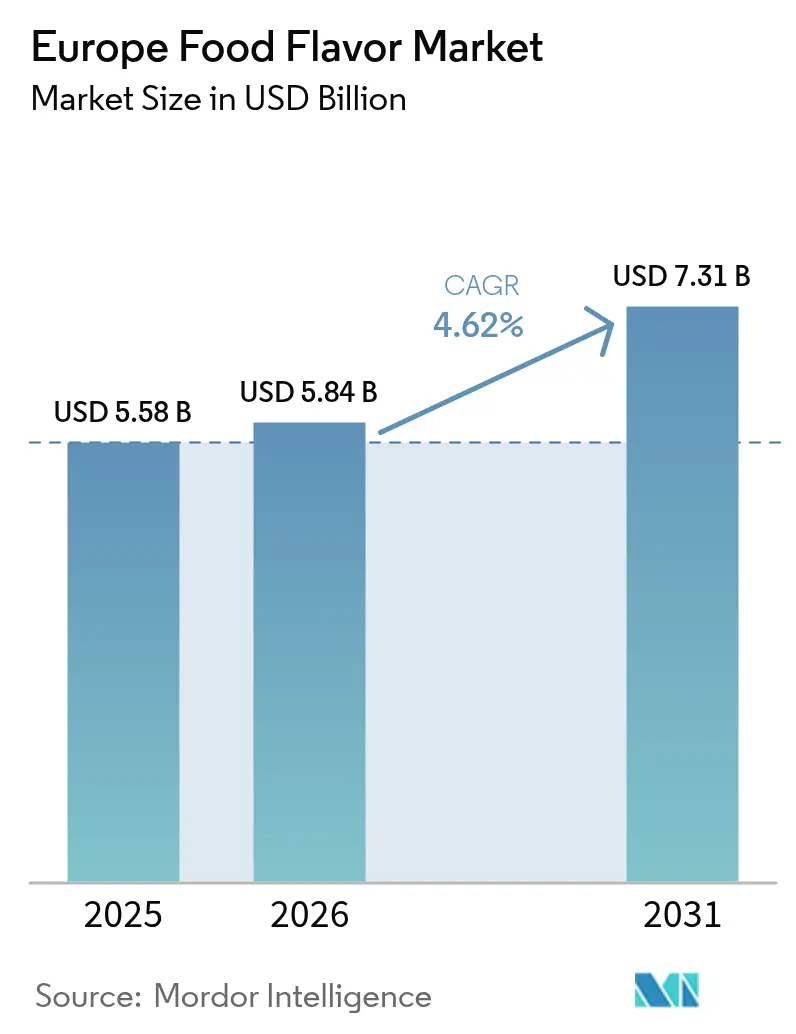
The European food flavoring market size was valued at USD 5.58 billion in 2025 and estimated to grow from USD 5.84 billion in 2026 to reach USD 7.31 billion by 2031, at a CAGR of 4.62% during the forecast period (2026-2031). Rising demand for natural and clean-label ingredients, capacity additions in European food processing, and rapid adoption of artificial-intelligence-guided formulation tools are shaping competitive positioning. Beverage producers are driving flavor masking innovations, while bakery manufacturers are experimenting with premium, region-specific taste profiles to win share. Powder and micro-encapsulated formats are gaining ground as manufacturers seek shelf-stable solutions that lower logistics risk. Meanwhile, intensifying EU safety reviews are elevating compliance costs, pushing smaller firms toward partnerships with technology-rich suppliers and regulatory consultants.
Key Report Takeaways
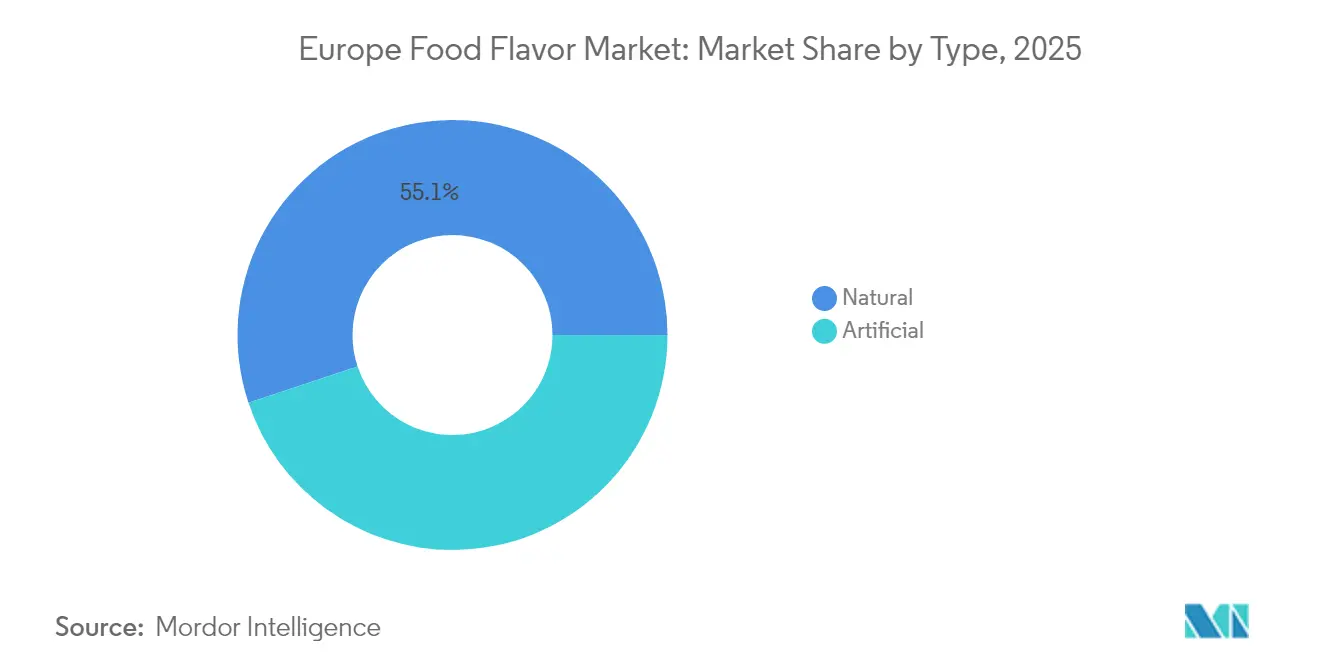
- By type, natural flavoring captured 55.10% of the European food flavoring market share in 2025; synthetic alternatives are projected to trail as the natural segment advances at a 6.25% CAGR through 2031.
- By form, liquid products led with 45.05% market share in 2025, whereas powder formulations are forecast to deliver the highest 6.45% CAGR over 2026-2031.
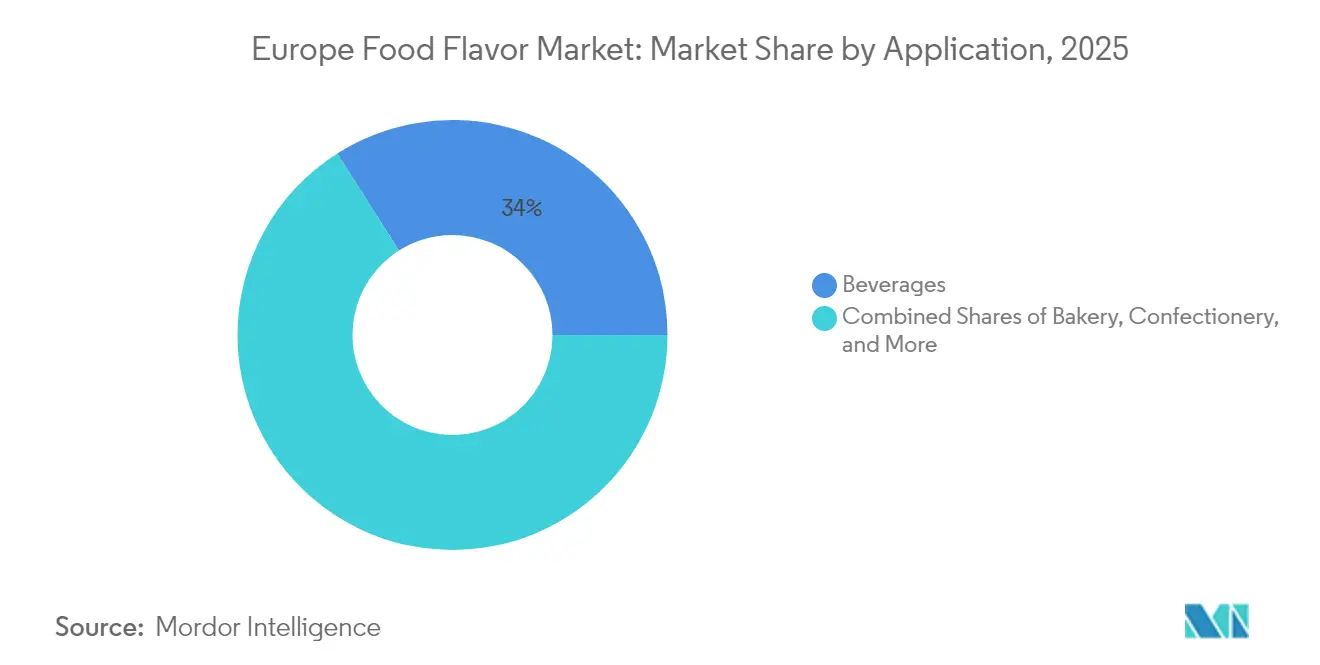
- By application, beverages accounted for 34.00% of the European food flavoring market share in 2025, while bakery & confectionery is set to post the fastest 6.68% CAGR to 2031.
- By geography, Germany dominated with 25.20% market share in 2025; Spain is expected to register the quickest 6.05% CAGR between 2026 and 2031.
Note: Market size and forecast figures in this report are generated using Mordor Intelligence’s proprietary estimation framework, updated with the latest available data and insights as of 2026.
Europe Food Flavor Market Trends and Insights
Drivers Impact Analysis*
| Drivers | (~)% Impact on CAGR Forecast | Geographic Relevance | Impact Timeline |
|---|---|---|---|
| Rising demand for natural and clean-label ingredients | +1.2% | Global, strongest in Germany, Netherlands, UK | Medium term (2-4 years) |
| Growth of functional foods, beverages, and wellness products | +0.9% | Germany, France, Netherlands, with expansion to Spain, Italy | Long term (≥ 4 years) |
| Increasing popularity of personalized and customized flavor solutions | +0.7% | Germany, UK, France, early adoption in Netherlands | Medium term (2-4 years) |
| Expansion of processed food & beverage industry | +0.8% | Spain, Germany, France, emerging in Eastern Europe | Long term (≥ 4 years) |
| Growing interest in vegan and cruelty-free ingredients | +0.5% | UK, Germany, Netherlands, spreading to Nordics | Short term (≤ 2 years) |
| AI-driven flavor co-creation with European craft brands | +0.4% | Germany, UK, France, pilot programs in Belgium | Medium term (2-4 years) |
| Source: Mordor Intelligence | |||
Rising Demand for Natural and Clean-Label Ingredients
With consumers increasingly favoring natural flavoring substances, regulators are aligning safety standards with market demands. The European Food Safety Authority (EFSA)[1]EFSA Panel on Food Additives and Flavourings, “Flavouring Group Evaluation 413: Naringenin,” efsa.europa.eu recently assessed naringenin, a citrus-derived compound, as a new food flavoring. Following extensive toxicological evaluations, EFSA determined there were no safety concerns at the proposed usage levels. This decision highlights the growing acceptance of naturally-derived flavoring compounds that meet strict safety criteria. In Europe, importers are placing greater emphasis on sustainability credentials and traceability documentation from natural ingredient suppliers, driven by initiatives like the European Green Deal and the Corporate Sustainability Due Diligence Directive. Additionally, the focus on transparency extends beyond consumer preferences, with companies implementing blockchain-based systems to trace the origins of natural ingredients, according to the CBI[2]CBI/ProFound, “Trends in Natural Ingredients,” cbi.eu. Biotechnology firms are also advancing fermentation-based production methods, ensuring consistent quality while meeting clean-label requirements, thereby accelerating the adoption of natural flavorings in the market.
Growth of Functional Foods, Beverages, and Wellness Products
Modern functional beverage formulations demand advanced flavor masking and enhancement techniques that traditional methods cannot adequately address. According to Kerry's 2025 consumer research conducted across 18 countries, cognitive health, immune health, and digestive health are the primary consumer priorities. This has driven the need for flavoring solutions that integrate seamlessly with functional ingredients while preserving their effectiveness. The functional foods market increasingly relies on specialized flavoring expertise to mask bitter compounds, improve the palatability of protein isolates, and develop appealing taste profiles for innovative ingredients like plant-based proteins and bioactive compounds. European manufacturers are heavily investing in flavor encapsulation technologies, which protect sensitive functional ingredients and deliver precise taste experiences. This trend aligns with the rise of personalized nutrition, where flavoring systems must address individual dietary needs and preferences without compromising functional benefits. The complexity of functional food formulations calls for stronger collaboration between flavor houses and functional ingredient suppliers to enhance both taste and efficacy.
Increasing Popularity of Personalized and Customized Flavor Solutions
AI-driven flavor development platforms are now equipping mid-market food manufacturers with the ability to achieve mass customization, a capability that was previously not economically viable. For example, Symrise's Symvision AI™ technology highlights how machine learning algorithms can forecast consumer preferences and develop targeted flavor profiles for specific demographics and regional tastes. In Europe, craft food manufacturers are utilizing these advanced technologies to stand out in crowded markets. They are introducing limited-edition flavors and seasonal variations while significantly reducing development costs. This personalization trend is not limited to consumer products; it is also gaining traction in B2B applications. Food service operators increasingly require customized flavoring solutions tailored to specific menu items and regional preferences. With access to digital flavor libraries and rapid prototyping capabilities, European companies can quickly adapt to emerging taste trends and cultural preferences. This adaptability is particularly critical in Europe, where diverse cultural preferences and varying regulatory requirements across countries demand flexible approaches to flavor development.
Expansion of Processed Food & Beverage Industry
The expansion of food processing capacities across Europe is driving consistent demand for flavoring ingredients across diverse product categories and regions. Germany's food processing industry, valued at USD 218.5 billion in 2022, ranks as the nation's fourth-largest industrial sector and recorded a 17% growth compared to the previous year. Key investments include Paulig's EUR 42 million facility in Spain, which will produce Tex-Mex and snacks by 2026, and Mueller's EUR 100 million initiative in Germany, focusing on plant-based beverages. In 2025, Romania's Ministry of Agriculture announced a EUR 2 billion program to enhance agricultural processing, aiming to improve processing capacities and boost export capabilities. These investments are driving demand for flavoring solutions while creating regional production hubs that require localized flavor development. This growth trend is supported by government initiatives and EU funding, emphasizing food security and export competitiveness.
Restraints Impact Analysis*
| Restraints | ~) % Impact on CAGR Forecast | Geographic Relevance | Impact Timeline |
|---|---|---|---|
| Stringent European regulations on the use of additives | -0.8% | EU-wide, particularly strict in Germany, Netherlands | Long term (≥ 4 years) |
| Volatility in raw material prices | -0.6% | Global impact, acute in import-dependent regions | Short term (≤ 2 years) |
| Challenges in scaling up new sustainable or biotechnology-derived ingredients | -0.4% | Germany, Netherlands, France, Denmark | Medium term (2-4 years) |
| Rising Health Concerns over the use of Artificial Flavoring | -0.5% | UK, Germany, France, spreading across EU | Medium term (2-4 years) |
| Source: Mordor Intelligence | |||
Stringent European Regulations on the Use of Additives
In 2023, the European Food Safety Authority (EFSA) conducted a reassessment of smoke flavoring primary products, concluding that all eight reviewed compounds were unsafe due to genotoxic concerns. This determination, supported by the German Federal Institute for Risk Assessment[3]German Federal Institute for Risk Assessment, “Smoke Flavourings in Food,” bfr.bund.de, could lead to the removal of entire product categories from European markets. The stricter regulations align with updated scientific guidelines that call for more sensitive genotoxicity testing and detailed evaluations of complex flavor mixtures. In 2024, the International Agency for Research on Cancer categorized methyleugenol as "probably carcinogenic to humans" (Group 2A) and isoeugenol as "possibly carcinogenic to humans" (Group 2B), illustrating how advancing scientific knowledge can challenge the use of previously accepted flavoring compounds. European manufacturers are facing higher compliance costs as regulatory authorities demand extensive safety data for new flavoring substances and re-evaluate existing approvals using modern testing methods. This changing regulatory environment benefits companies with strong regulatory affairs capabilities, while smaller players, lacking the resources for comprehensive safety assessments, may struggle to compete.
Volatility in Raw Material Prices
In 2024, European food processing companies faced ongoing cost pressures. Increased raw material costs and energy taxes significantly raised production expenses, particularly in the Netherlands and other major manufacturing regions, as reported by the U.S. Department of Agriculture's Foreign Agricultural Service. Natural flavoring ingredients experienced notable price volatility due to agricultural commodity fluctuations, weather-related crop variations, and geopolitical disruptions in supply chains from key producing regions. Additionally, European flavor manufacturers, heavily reliant on imported essential oils and botanical extracts from developing countries, were exposed to currency fluctuations and changes in trade policies. The energy-intensive processes required for extracting and processing natural flavoring compounds further exacerbated cost volatility, with European energy prices remaining higher than historical averages. To address these challenges, companies adopted strategic sourcing and vertical integration strategies. However, these measures involve substantial capital investments and long-term supply commitments, which may limit operational flexibility.
*Our forecasts treat driver/restraint impacts as directional, not additive. The impact forecasts reflect baseline growth, mix effects, and variable interactions.
Segment Analysis
By Type: Natural Ingredients Drive Market Evolution
In 2025, natural flavoring substances accounted for 55.10% of the market share and are expected to grow at a strong 6.25% CAGR from 2026 to 2031. This trend highlights their sustained momentum, reinforcing their current dominance and signaling continued growth. This dual leadership reflects increasing consumer preferences aligned with regulatory trends favoring naturally-derived compounds over synthetic alternatives. Although synthetic flavoring retains a significant market share, its growth rate is slower. Synthetic options cater to applications where cost efficiency and consistent supply are prioritized over clean-label attributes. On the other hand, the natural segment benefits from advancements in biotechnology and fermentation, enabling scalable production of complex flavor compounds that were previously achievable only through synthetic chemistry.
EFSA's (European Food Safety Authority) evolving regulatory framework is reshaping the competitive landscape, favoring natural ingredient suppliers with strong safety documentation and traceability systems. For instance, EFSA's recent approval of naringenin derived from grapefruit peel extraction illustrates the potential for commercializing natural compounds. However, the extensive toxicological evaluations required create significant barriers for smaller suppliers. To address concerns about batch-to-batch variability in plant-derived ingredients, biotechnology companies are developing precision fermentation techniques that ensure consistent quality in natural flavoring compounds. The growth of the natural segment is further supported by increased investments in sustainable production methods and supply chain transparency initiatives, aligning with strict European sustainability standards.



By Form: Liquid Dominance Faces Powder Innovation
In 2025, liquid formulations hold a leading 45.05% market share, attributed to their excellent solubility and the well-established processing infrastructure of European food manufacturers. At the same time, powder formulations are gaining traction, with a projected 6.45% CAGR from 2026 to 2031, driven by the need for extended shelf life and convenience in dry food products. Micro-encapsulated forms address specialized requirements, offering controlled release, flavor protection, and targeted delivery. This segmentation highlights advancements in flavor delivery technologies and the shifting priorities of food manufacturers aiming for efficiency and product differentiation.
European manufacturers are increasingly adopting powder flavorings, supported by investments in spray-drying and encapsulation technologies. These innovations help preserve volatile compounds while improving handling and storage. Micro-encapsulation technologies are evolving rapidly, expanding their applications from traditional uses to include probiotic protection, nutrient stabilization, and time-released flavor profiles. Although European regulatory frameworks for novel food processing methods create opportunities for companies developing advanced encapsulation techniques, the approval process remains stringent, requiring comprehensive technical documentation and safety validation.
By Application: Beverage Leadership Meets Bakery Innovation
In 2025, the beverages segment holds a 34.00% market share, highlighting the diversity of Europe's beverage industry, which includes traditional alcoholic drinks, functional beverages, and plant-based options. The bakery sector is experiencing robust growth, with a 6.68% CAGR projected from 2026 to 2031, driven by premiumization trends and the development of artisanal products across Europe. Dairy applications continue to see steady demand as manufacturers focus on lactose-free and plant-based alternatives, requiring advanced flavoring solutions. Similarly, savory snacks are benefiting from the growth of the European snack food industry and increasing consumer interest in ethnic and international flavors.
Meat applications face challenges as European consumers increasingly adopt flexitarian diets, driving demand for plant-based alternatives that rely on advanced flavoring technologies to replicate traditional meat flavors. Circular Food Solutions exemplifies innovation in this space with its wet-extruded plant-based meat substitutes made from brewer's spent grains, combining sustainability with specialized flavoring expertise. Additionally, emerging categories such as functional foods, personalized nutrition products, and alternative protein sources are driving the need for novel flavoring approaches. This diverse application landscape reflects Europe's sophisticated food culture and regulatory framework, which fosters innovation while ensuring safety standards are met.
Geography Analysis
In 2025, Germany strengthens its position as Europe's largest food flavoring market, holding a 25.20% share. This leadership is supported by the country's strong food processing infrastructure, valued at EUR 218.5 billion, which ranks as the fourth-largest industrial sector in Germany. The German market benefits from its proximity to major flavor houses, such as Symrise, and its location near key food manufacturing clusters that require advanced flavoring solutions. France and the Netherlands play significant roles as secondary markets, leveraging their established food processing traditions and strategic positions as European distribution hubs for imported natural ingredients. Despite trade adjustments following Brexit, the United Kingdom continues to maintain a notable presence, driven by ongoing demand for premium flavoring solutions in artisanal food and beverage sectors.
Spain is the fastest-growing European market, with a 6.05% CAGR projected from 2026 to 2031. This growth is driven by substantial investments in food processing and a focus on export-oriented production. For example, Paulig's EUR 42 million investment in Spanish Tex-Mex and snacking production, expected to become operational by 2026, highlights the capacity expansion fueling flavoring demand. Italy experiences steady growth, supported by its diverse food processing sector and increasing export activities. Belgium has established itself as a specialized hub for confectionery and chocolate flavoring. Eastern European markets, including Russia, show potential for growth; however, geopolitical challenges create uncertainties regarding long-term prospects and regulatory alignment with EU standards.
Regional market dynamics reflect diverse consumer preferences, regulatory frameworks, and industrial capabilities, all of which influence flavoring demand across Europe. The Netherlands faces cost pressures due to rising energy taxes and raw material expenses, which impact the economics of flavor-intensive production. Romania's EUR 2 billion agricultural processing development program, set to launch in 2025, positions the country as an emerging market for flavoring applications, particularly in meat and dairy processing. This geographic diversity offers opportunities for specialized flavor companies to create region-specific solutions while navigating the varied regulatory requirements and cultural preferences across European markets.
Regulatory Landscape
The European food flavor market operates under the EU food improvement agents framework, with Regulation (EC) No 1334/2008 governing flavourings and Regulation (EC) No 1333/2008 covering food additives. In January 2026, the European Commission updated the Union list by authorizing additional flavouring substances, including 3-[3-(2-isopropyl-5-methyl-cyclohexyl)-ureido]-butyric acid ethyl ester (FL No 16.136) under Regulation (EU) 2026/172 and hesperetin dihydrochalcone (FL No 16.137) under Regulation (EU) 2026/175, which keeps the focus on dossier preparation and traceability in supplier approvals.
Regulatory pressure also comes from restrictions and evolving safety guidance. Commission Implementing Regulation (EU) 2024/2067 mandated deletion of smoke flavouring primary products (SF-001 to SF-010) from the Union list, with phase-out deadlines set for July 1, 2026 for most food categories, which is pushing reformulation and alternative flavor system adoption. Separately, Regulation (EU) 2026/196 updated specifications and uses for multiple hydrocolloids, with compliance required by August 18, 2026, while EFSA updated food additive application guidance with new data requirements applicable to submissions from July 20, 2026, raising the bar for analytical data, exposure assessment, and documentation for new and reformulated flavor solutions.
Value Chain Analysis
Europe's food flavor value chain starts with agricultural and bio-based feedstocks (botanicals, citrus, spices, fermentation substrates) and specialty intermediates used in process flavors, then moves through extraction and distillation, chemical synthesis or reaction flavor manufacture, and compounding into liquid, powder, and encapsulated formats. Large flavor houses and regional blenders typically run application labs and customer co-creation workflows, followed by quality control, regulatory documentation (aligned with Regulation (EC) No 1334/2008/1333/2008), and distribution to food and beverage manufacturers. Demand for short development cycles and consistent lot-to-lot performance is strongest where beverages and bakery manufacturers pull innovation through masking needs and region-specific profiles.
Supply is structurally exposed to import dependence and logistics volatility, particularly for globally sourced natural materials and key intermediates used in process flavors, which increases the importance of supplier qualification, traceability, and multi-sourcing. In 2025-2026, EFSA's pilot data-collection program (M-2022-00210) for analytical, use-level, and presence data expands compliance-driven data flows across the chain, increasing the role of analytical testing partners and robust documentation from upstream suppliers. In 2026, longer Asia-Europe transit times and container circulation bottlenecks, alongside renewed pressure on energy and fertilizer-linked input costs, is sharpening focus on resilient sourcing, inventory strategies, and localized European compounding capacity for shelf-stable powder and encapsulated flavor formats.
Competitive Landscape
The European food flavoring market operates with fragmented competitive dynamics, creating opportunities for specialized players to capture niche segments through innovation and regulatory expertise. Major multinational flavor houses, including Givaudan, DSM-Firmenich, IFF, and Symrise, compete alongside regional specialists and emerging biotechnology companies developing novel production methods. Strategic patterns emphasize AI-driven flavor development, sustainable ingredient sourcing, and vertical integration approaches that reduce supply chain vulnerabilities while enhancing product differentiation capabilities.
Technology deployment has become a primary competitive differentiator, with companies investing heavily in artificial intelligence platforms for flavor prediction and consumer preference analysis. Symrise's Symvision AI platform and DSM-Firmenich's AI-created flavor compounds demonstrate how machine learning applications are accelerating product development cycles and enabling mass customization capabilities.
White-space opportunities exist in personalized nutrition applications, sustainable ingredient production through precision fermentation, and regulatory navigation services for companies seeking European market entry. Emerging disruptors include biotechnology companies developing novel production methods and digital platforms connecting craft food manufacturers with specialized flavoring solutions. EFSA's stringent evaluation requirements create regulatory moats that favor companies with established safety assessment capabilities and comprehensive technical documentation systems.
Europe Food Flavor Industry Leaders
Kerry Group Plc
BASF SE
DSM-Firmenich
Givaudan SA
International Flavors & Fragrances Inc. (IFF)
- *Disclaimer: Major Players sorted in no particular order


Market Opportunities and Future Outlook
Capacity localization and powder-format capability upgrades are creating near-term whitespace for suppliers that can deliver shelf-stable, scalable flavors while meeting clean-label and documentation demands. Symrise opened an upgraded Food and Beverage site near Barcelona in April 2026, adding modernized development and quality labs and a large-scale mixing plant for powdered products, which points to continued investment in regional hubs designed for fast iteration and industrial-scale dry blending. Suppliers are also aligning investments in automated mixing, spray drying, and encapsulation with customer needs in beverages and bakery, where masking, flavor protection, and controlled release support functional and premium formulations.
Natural flavor manufacturing and biotech-derived aroma ingredients are another opportunity cluster, supported by both customer pull and regulatory pathways for new substances under the EU flavourings framework. In February 2026, I.T.S acquired an 8.2-acre site near Hungerford, UK, committing GBP 10 million to build a natural flavor manufacturing facility designed to materially expand output, underscoring momentum in natural capacity and traceable sourcing. In parallel, the European Commission's authorizations of new flavouring substances in 2025 and January 2026 expand the approved toolbox for formulators, while the smoke flavouring phase-out deadline of July 1, 2026 is pushing manufacturers toward alternative flavor systems, including reaction flavors and natural smoke replacers, favoring suppliers with strong regulatory affairs, analytical substantiation, and reformulation support.
Recent Industry Developments
- April 2026: Kerry Group Plc reported actions to expand proactive health capacity and capabilities in Spain as part of its Q1 2026 update. The move reinforces localized development and production support for European customers working on functional foods and beverages where taste masking and health-positioned formulations are central.
- March 2025: BASF SE launched Isobionics Natural beta-Sinensal 20 and Isobionics Natural alpha-Humulene 90 under its Isobionics biotech brand. These biotech-derived aroma ingredients broaden options for natural positioning and help formulators reduce reliance on agriculturally constrained inputs while maintaining sensory consistency.
- April 2024: IFF inaugurated its Co-Creation Center in Wageningen to deepen collaboration with customers and partners on food ingredients, including flavor systems. The center strengthens application-led development capacity in Europe, supporting faster prototype iteration and integrated solutions across beverage, dairy, bakery, and savory categories.


Research Methodology Framework and Report Scope
Market Definition and Coverage
This market covers flavoring ingredients sold for use in food and drink manufacturing across Europe, including natural, nature-identical, and synthetic flavors in common commercial forms. We treat the market as ingredient value, not finished retail food value.
Scope exclusions: We exclude retail-ready foods, kitchen spices sold to consumers, and fragrances used mainly for personal care or home care products.
Segmentation Overview
- Type
- Synthetic
- Natural
- Form
- Powder
- Liquid
- Micro-Encapsulated
- Application
- Dairy
- Bakery
- Confectionery
- Savory Snack
- Meat
- Beverage
- Other Applications
- Geography
- United Kingdom
- Germany
- France
- Spain
- Italy
- Netherlands
- Belgium
- Russia
- Rest of Europe
Data Validation & Update Cycle
Validation is done through a set of cross-checks that compare the model output with independent signals, then with directional feedback from industry participants. If any country or application line shows an unusual jump, we revisit assumptions on penetration, pricing, or trade allocation and re-contact the relevant experts before sign-off.
A multi-step analyst review is completed so calculation logic, units, and currency conversions remain consistent across the dataset. The report is refreshed annually, and it can be updated earlier when material events occur, such as major regulatory changes or sharp input-cost movements. Before delivery, a final review pass is run so clients receive the most current view available at that time.
Mordor Intelligence's Europe Food Flavor Market Sizing Compared With Other Published Estimates
Published market values for Europe food flavors do not always match, even when the topic looks the same on the cover page. Differences usually come from what is counted as a flavor ingredient, whether beverages are included inside the same total, and how prices are translated into a single USD value for a given year.
A second gap driver is the modeling path, since some estimates lean heavily on a single indicator like packaged food growth, while others extend the scope to adjacent areas that buyers may not expect, such as non-food flavor uses. The table also reflects timing effects, since assumptions like mix shift toward natural flavors and the currency conversion month can change the reported value, and the update cadence can lag fast-moving inflation periods.
Benchmark comparison
| Source | Market Size | Gaps in Research Methodology |
|---|---|---|
| Mordor Intelligence | USD 5.58 B (2025) | |
| Regional Consultancy A | USD 4.35 B (2024) | This estimate is anchored to a different base year and typically reflects a narrower pricing and application build, which can understate value when mix shifts and inflation are carried into later years. |
| Industry Research Group B | USD 4.86 B (2025) | This figure is scoped to food-only flavors, with beverages and other end uses treated separately, which lowers the total versus a combined food plus beverage ingredient view. |
What stands out is that the spread is largely explained by application scope, year selection, and how price and mix are handled, rather than a single disagreement on growth rate. When beverage applications are kept inside the same ingredient total and country-level checks are used to avoid double counting in trade flows, the 2025 value aligns to the broader demand pool modeled by Mordor Intelligence.


Key Questions Answered in the Report
What is the projected value of Europe’s food flavoring market by 2031?
The sector is forecast to reach USD 7.31 billion by 2031.
Which segment is growing the fastest within European food flavoring applications?
Bakery applications are expected to grow at a 6.68% CAGR through 2031.
Which country leads European demand for food flavorings?
Germany holds the largest share, accounting for 25.20% of 2025 revenue.
Why are powder flavor formats gaining popularity?
Powder forms offer longer shelf life and easier logistics, supporting a 6.45% CAGR forecast between 2026 and 2031.
Page last updated on:






