
Chia Seeds Market Analysis by Mordor Intelligence
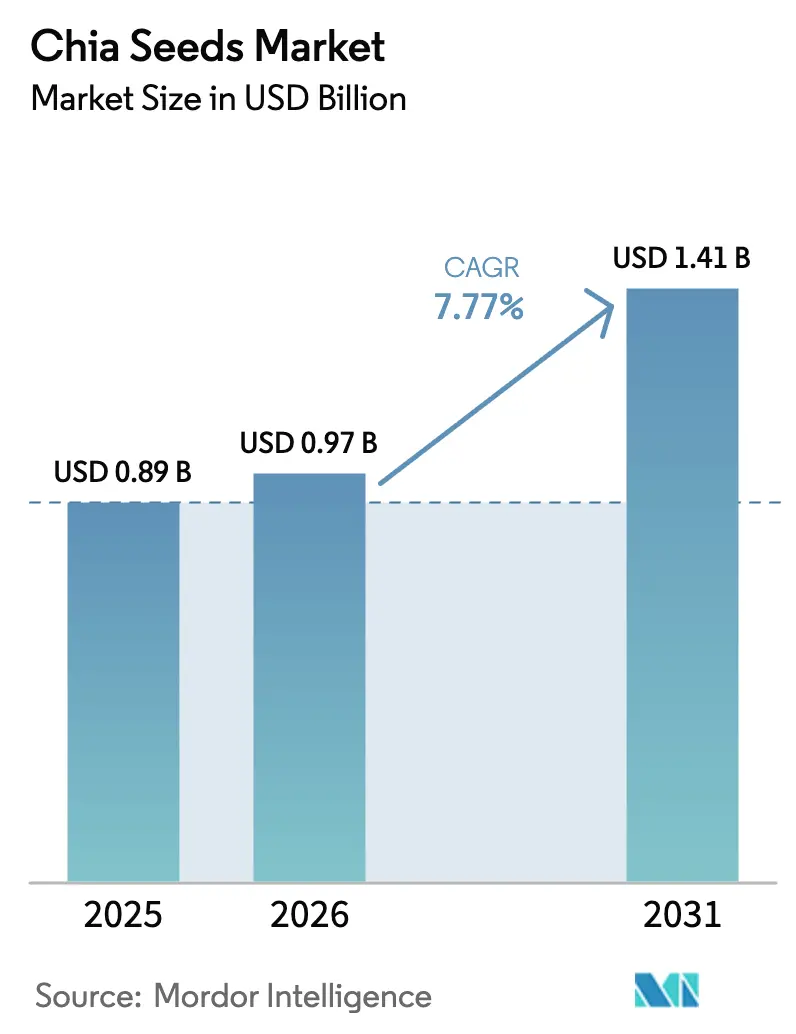
The chia seeds market size was valued at USD 0.89 billion in 2025 and is estimated to reach USD 0.97 billion in 2026, further projected to grow to USD 1.41 billion by 2031, delivering a CAGR of 7.77% during the forecast period (2026–2031). The growing shift of consumers toward plant-based omega-3s, functional food reformulation, and organic premiumization underpin this expansion. South America supplies approximately 80% of the global output, yet consumption in the Asia-Pacific region is rising at a faster rate, as importers in China and India scale up their procurement. Drought-tolerant cultivar releases are enhancing farm yields, even as speculative trading causes 30% annual price fluctuations that impact procurement planning. Whole seeds command the bulk of demand for bakery and beverage inclusion, although protein-rich fractions are gaining momentum as nutraceutical players seek higher margins. Regulatory clarity under the Food and Drug Administration (FDA) and the European Food Safety Authority (EFSA) Novel Food rules simplifies label compliance for multinational brands.
Key Report Takeaways
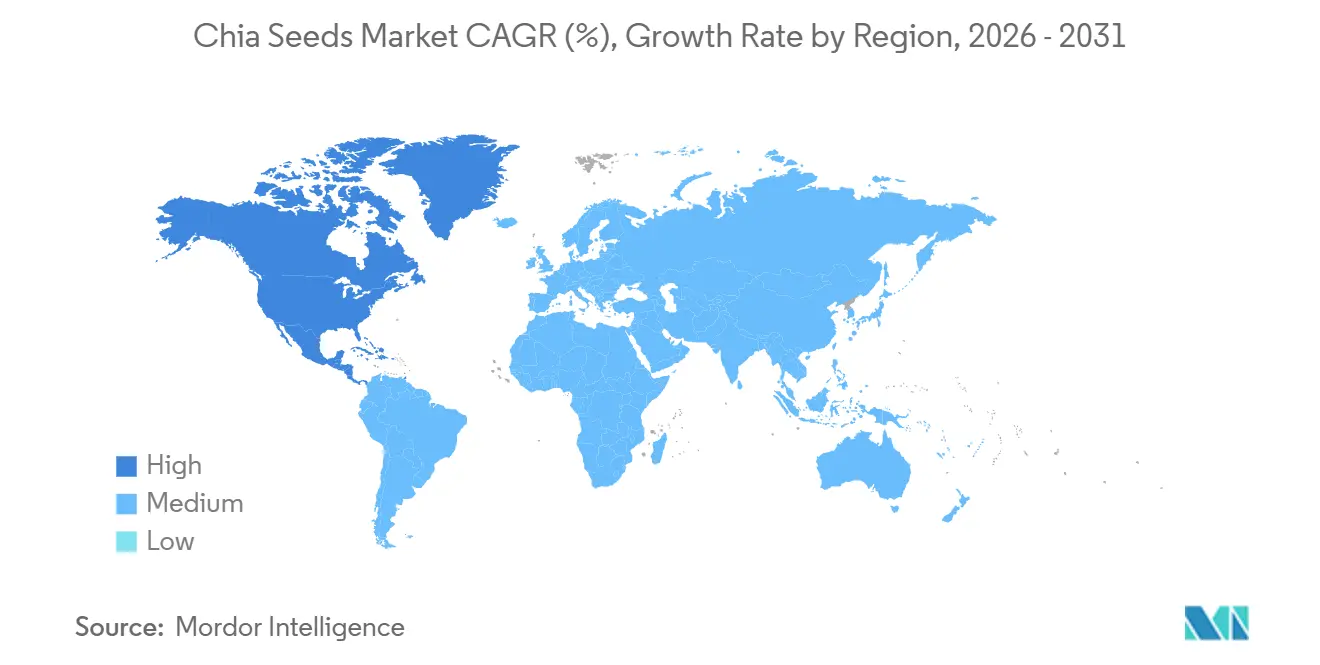
By geography, North America accounted for 34% of the chia seeds market share in 2025, whereas the Asia-Pacific is projected to experience the fastest regional growth at a 7.8% CAGR through 2031.
Note: Market size and forecast figures in this report are generated using Mordor Intelligence’s proprietary estimation framework, updated with the latest available data and insights as of January 2026.
Global Chia Seeds Market Trends and Insights
Drivers Impact Analysis*
| Driver | (~) % Impact on CAGR Forecast | Geographic Relevance | Impact Timeline |
|---|---|---|---|
| Growing global demand for plant-based omega-3 sources | +1.8% | Global, with the strongest uptake in North America, Europe, and Asia-Pacific urban centers | Medium term (2-4 years) |
| Expansion of functional food and beverage manufacturing using chia ingredients | +1.5% | North America, Europe, Asia-Pacific (China, India, and Japan) | Short term (≤ 2 years) |
| Rising price premiums for certified organic chia | +1.2% | Europe, North America, with spillover to Australia and select Middle Eastern markets | Medium term (2-4 years) |
| Government-backed super-food export promotion programs | +0.9% | South America (Bolivia, Paraguay, and Peru), with trade-fair support extending to the Middle East and Asia | Long term (≥ 4 years) |
| Innovative chia-derived ingredient launches (protein isolate, fiber concentrates) | +1.4% | Global, led by North America and Europe, for nutraceutical formulations | Medium term (2-4 years) |
| Climate-resilient cultivar development boosting yields | +0.8% | South America (Argentina, Bolivia, and Paraguay), with pilot adoption in Australia and East Africa | Long term (≥ 4 years) |
| Source: Mordor Intelligence | |||
Growing Global Demand for Plant-Based Omega-3 Sources
The shift from marine-derived omega-3 to terrestrial alternatives is transforming ingredient sourcing in the supplement and functional food markets. Chia seeds provide alpha-linolenic acid concentrations ranging from 55% to 64% of total fatty-acid content, surpassing flax in terms of mucilage functionality and shelf stability. In 2021, European organic retail sales reached EUR 54 billion (USD 56.7 billion), representing a 3.8% year-over-year increase. Additionally, plant-based omega-3 claims appeared on 22% of new functional beverage launches in North America in 2024[1]Source: Organic Europe, “European Organic Retail Market Analysis 2021,” organiceurope.bio. This trend supports the growth of multi-ingredient blends over single-source omega-3 products, creating opportunities for algal-oil suppliers to collaborate on co-ingredient solutions. In the United States, plant-based omega-3 capsules command an average retail price premium of 18% over fish-oil equivalents, providing margin advantages for vertically integrated chia processors managing seed sourcing and encapsulation.
Expansion of Functional Food and Beverage Manufacturing Using Chia Ingredients
Beverage manufacturers are utilizing chia mucilage as a natural thickener and omega-3 carrier, reducing reliance on synthetic hydrocolloids and lowering clean-label compliance costs. In March 2025, Benexia introduced a chia milk line targeting lactose-intolerant consumers in Chile and Argentina. Similarly, Glanbia Nutritionals launched BevChia, CuisineChia, and SnackChia ingredient systems in 2025 to enhance texture and nutritional value in ready-to-drink smoothies and protein bars. In December 2024, Nourish released the first instant chia protein pudding, combining pea protein isolate with pre-hydrated chia gel to deliver 15 grams of protein per serving, eliminating the need for refrigeration. Functional beverage launches featuring chia seeds increased by 34% in the Asia-Pacific region in 2024, driven by startups in China and India catering to urban millennials who are willing to pay premiums of 25% to 30% for plant-based protein and fiber claims.
Rising Price Premiums for Certified Organic Chia
Certified organic chia commands a 15% to 20% price premium over conventional seeds in European and North American wholesale markets, encouraging smallholders in Bolivia and Paraguay to convert acreage to organic farming. Germany alone imported 4.5 to 5 kilotons of chia in 2022, accounting for 7.3% of the European revenue share. Certification costs, ranging from USD 1,500 to USD 3,000 per farm annually, pose challenges for producers with less than five hectares, unless they are part of a cooperative. In 2024, Olam Agri supported over 2,100 farmers in Peru with organic certification and sustainability programs, showcasing scalable models for smallholder inclusion. In the United States, retail price premiums for organic chia were 22% above those for conventional alternatives in 2024, reinforcing incentives for certified acreage expansion.
Government-Backed Super-Food Export Promotion Programs
Bolivia provided freight rebates and trade-fair subsidies for chia exporters, resulting in annual shipments exceeding 10,000 metric tons to 35 countries and generating USD 26.3 million in export revenues in 2023. Peru recorded USD 7.2 million in chia and jojoba exports during the first half of 2024, supported by trade missions and streamlined phytosanitary certification processes. In March 2025, Peru introduced a USD 24 billion investment in irrigation to expand arable land by 1.2 million hectares, with a focus on chia cultivation in semi-arid zones such as Arequipa and Tacna. Government support is most effective when aligned with harmonized phytosanitary certification standards, as differing pesticide residue limits in the European Union, United States, and Japan require exporters to segregate production batches, increasing storage and testing costs by 8% to 12%.
Restraints Impact Analysis*
| Restraint | (~) % Impact on CAGR Forecast | Geographic Relevance | Impact Timeline |
|---|---|---|---|
| Limited genetic diversity limiting adaptability beyond optimal latitudes | -0.7% | Global, with acute constraints in temperate-zone expansion (North America, Europe, and Australia) | Long term (≥ 4 years) |
| Volatile farm-gate prices due to speculative trading | -1.1% | South America (Bolivia, Paraguay, and Argentina), with price transmission to North America and Europe | Short term (≤ 2 years) |
| Contamination risks from pesticide drift in neighboring crops | -0.6% | South America, Europe (import rejections), with spillover to the Middle East and Asia | Medium term (2-4 years) |
| Supply bottlenecks in certified organic logistics | -0.5% | Global, most acute in South America export corridors and European import hubs | Medium term (2-4 years) |
| Source: Mordor Intelligence | |||
Limited Genetic Diversity Limiting Adaptability Beyond Optimal Latitudes
Commercial chia germplasm is derived from a limited genetic base of Mexican and Guatemalan landraces, restricting breeders' capacity to introduce traits such as photoperiod neutrality, pest resistance, and cold tolerance without relying on transgenic methods. A 2024 study published in the Crop Science Journal highlighted the crop's susceptibility to Alternaria leaf spot and aphid infestations in high-humidity environments, confining viable cultivation to semi-arid regions with relative humidity below 60% during flowering. Intellectual property constraints further hinder innovation, as most improved varieties remain under the public domain through the National Institute of Agricultural Technology (INTA) in Argentina. This discourages private sector investment in marker-assisted selection and genomic tools. The narrow genetic diversity also increases systemic risk, as widespread adoption of a single high-yielding cultivar could lead to significant losses if a novel pathogen emerges, similar to historical cases like banana Panama disease and wheat stem rust.
Volatile Farm-Gate Prices Due to Speculative Trading
Chia farm-gate prices fluctuated by 30% year-over-year between 2023 and 2024, influenced by speculative trading on thinly traded commodity exchanges and weather-related supply disruptions in Bolivia and Argentina[2]Source: UNCTAD, “Commodity Price Volatility and Agricultural Markets,” UNCTAD, unctad.org . Futures liquidity for chia remains minimal compared to crops like soy or wheat, with price discovery concentrated among fewer than 20 active traders, exacerbating volatility during South American harvest periods. Forecasted La Niña weather patterns for 2026 are projected to reduce South American chia yields by 15% to 20%, potentially causing supply shortages and pushing spot prices above USD 4.00 per kilogram. This could prompt North American and European buyers to deplete their inventories or reformulate their products. Smallholder farmers in Bolivia and Paraguay, lacking access to price-hedging tools, bear the full risk of price collapses during harvest periods, discouraging investments in organic certification and yield-enhancing inputs.
*Our forecasts treat driver/restraint impacts as directional, not additive. The impact forecasts reflect baseline growth, mix effects, and variable interactions.
Geography Analysis
North America accounted for 34% of the chia seeds market share in 2025, driven by the rising demand for chia seeds. This growth is largely attributed to the increasing popularity of vegan and plant-based diets, coupled with heightened health consciousness among consumers. In the United States and Canada, retailers and food manufacturers have expanded their product offerings to include chia seed-based products, reflecting the growing consumer interest in nutrient-rich superfoods. As a result, supermarket shelves now feature a wide range of chia seed products, aligning with the evolving dietary preferences of North American consumers.
Asia-Pacific is projected to experience the fastest regional growth at a 7.8% CAGR through 2031, driven by India's 34.48% year-over-year export growth in 2023, and Bolivia's 90% completion of administrative pathways to export chia into China by May 2024, a development that could redirect 10,000 metric tons from European and North American buyers[3]Source: Indian Ministry of Commerce, “Chia Seed Export Data 2023,” commerce.gov.in . In Europe, chia seeds are widely available in health shops, specialty stores, and mainstream supermarkets. Prominent retailers such as Tesco in the United Kingdom, El Corte Inglés in Spain, and Albert Heijn in the Netherlands have begun stocking chia seeds. Furthermore, their availability as food supplements in drugstores underscores the growing consumer interest in superfoods. The food industry in Europe is increasingly incorporating chia seeds into various products, utilizing them in forms such as whole seeds, flour, oil, and gel.
In the Middle East, chia seed consumption is expanding, supported by retail chains in Saudi Arabia and the United Arab Emirates (UAE) introducing chia-based health foods targeting expatriate and affluent local demographics. In Africa, production is still in its early stages, with Kenya and South Africa leading the way. African organic chia imports into the European Union doubled from 1,200 metric tons in 2018 to 2,800 metric tons in 2022, indicating a growth in exports. Peru's USD 24 billion irrigation investment introduced in March 2025 aims to expand arable land by 1.2 million hectares, with chia identified as a priority crop for semi-arid zones in the Arequipa and Tacna regions.


Regulatory Landscape
Chia seeds and derived ingredients sold into major import markets are governed by a mix of food-ingredient rules, organic standards, and border phytosanitary controls. In the European Union, chia seeds and certain processed forms (including partially defatted powders) fall under the Novel Food framework via the Union list (Regulation (EU) 2017/2470), which ties market access to defined conditions of use and labeling requirements. For organic trade into the EU, operators must comply with the organic regulation framework (Regulation (EU) 2018/848, consolidated as of March 2025), which reinforces documentation and segregation practices across certified flows.
In the United States, food-ingredient use routes through the Food and Drug Administration (FDA) framework, with GRAS pathways used to substantiate safety for intended uses, while importers also manage preventive controls and contamination risk (including microbiological hazards). China market entry places emphasis on General Administration of Customs of China (GACC) requirements, including registration of relevant processing enterprises and compliance with phytosanitary protocols and pesticide restrictions at the border. Import condition systems such as the Australian Government MICoR illustrate the operational bar for pest, soil, and extraneous-matter controls that exporters increasingly align to across destinations.
Value Chain Analysis
The chia seeds value chain begins with input sourcing and cultivation, which remains concentrated in South America (notably Paraguay, Bolivia, and Argentina), followed by aggregation through local collectors and cooperatives, primary processing (cleaning, sorting, gravity separation, and de-stoning), and then secondary processing where applicable (milling into powder, fiber/protein fractionation, and oil extraction). Exporters ship in bulk or consumer-ready packs to international importers and distributors, who supply food and beverage manufacturers, nutraceutical brands, and retail channels. Packaging and storage management (moisture and oxidation control) is critical because quality downgrades can cascade into rejected lots, relabeling, or lower-value use cases.
Key friction points sit between harvest windows and export execution, where climate-driven yield variability, port congestion, and inland logistics constraints can tighten available supply and amplify price swings. Compliance and quality assurance are embedded across the chain through pesticide-residue management, microbiological controls, and traceability. Buyers frequently ask for recognized food-safety systems alongside country-specific import and organic documentation. As demand grows for value-added formats (powders, fiber, protein, and oil), the margin center shifts toward processors with validated separation, extraction, and lot-release capabilities. Origin diversification, including emerging hubs such as India, Kenya, and Uganda, functions as a practical hedge when South American corridors face disruptions.
Competitive Landscape
The chia seed market encompasses a diverse range of participants, including producers, importers, and exporters, with opportunities for mid-tier entrants to focus on niche segments such as white-seed organic products or value-added protein isolates. Vertical integration remains a significant strategy among leading companies. The Chia Company oversees farming, processing, and retail distribution, securing USD 49 million across three funding rounds and expanding its ready-to-eat breakfast product line in January 2025. Similarly, Benexia has diversified its operations by moving downstream into finished goods, launching chia milk in March 2025, and introducing chia protein and fiber extracts to European ingredient markets within the same year. These initiatives illustrate how established exporters are moving beyond bulk seed offerings.
Emerging innovators are also transforming the market. For instance, Nourish launched the first instant chia protein pudding in December 2024. This product combines pea protein isolate with pre-hydrated chia gel, providing 15 grams of protein per serving while eliminating the need for refrigeration. This innovation circumvents cold-chain logistics, which typically increase distribution costs by 12 to 18%. Additionally, advancements in supercritical CO₂ extraction technology have enabled the development of premium products. Maya Chia, for example, employs patented extraction methods to produce facial oils priced between USD 48 and USD 125, targeting high-margin beauty markets.
Blockchain traceability is emerging as a critical competitive advantage, particularly as European importers demand end-to-end visibility to mitigate certification fraud and pesticide-residue risks. A July 2024 Food and Drug Administration (FDA) recall related to Salmonella contamination highlighted these concerns. Smaller players, such as Chia Sisters in New Zealand, have achieved B Corp and Zero Carbon certifications, appealing to environmentally conscious consumers who are willing to pay premiums of 20-25% for verified sustainability claims. Additionally, patent filings for chia peptide isolation increased by 18% between 2023 and 2024, reflecting growing pharmaceutical interest in bioactive sequences with antioxidant and ACE-inhibitory properties. This trend indicates potential for high-margin therapeutic applications beyond the food and cosmetics industries.
Market Opportunities and Future Outlook
A clear opportunity is expanding supply beyond the South American core, where origin concentration contributes to procurement volatility and batch segregation costs for exporters serving multiple residue-limit regimes. Evidence of cultivation spread is visible in India, where ATMA Nagpur reported expanded chia cultivation to around 500 acres across 12 talukas during the rabi season (reported April 2026). This supports a pathway for supplemental sourcing closer to fast-growing Asia-Pacific demand centers. For buyers and processors, it also creates room for contract farming arrangements, seed supply partnerships, and localized cleaning and sorting capacity aimed at meeting export-grade specifications.
Product-side opportunity continues to shift from bulk seeds toward higher-margin, specification-led ingredients used in functional foods and nutraceuticals, including fiber and protein fractions and edible chia oil formats. Distribution-focused scaling is also active: Benexia has broadened downstream commercialization through partnerships and expanded formats for chia oil, while European ingredient channels have been used to place chia fiber and protein into multiple countries through distributor agreements. In parallel, agronomy research on nutrient management and precision irrigation, including silicon supplementation trials and drip fertigation work in South Asia, plus moisture-regime studies, supports practical yield-improvement programs for newer origins. The objective is consistent quality and oil-content outcomes for premium applications.
Recent Industry Developments
- February 2026: Benexia introduced a new 500 mL bottle format for its Chia Oil, positioning chia oil as an everyday omega-3 option rather than a niche ingredient. The change supports wider retail and foodservice placement and strengthens downstream branding in a market where value is shifting toward processed chia derivatives.
- March 2025: Benexia launched a chia milk line targeting lactose-intolerant consumers in Chile and Argentina, extending its footprint from bulk and ingredient supply into finished dairy-alternative products. The launch reflects how vertical integration and proprietary extraction know-how are being used to compete with established plant-based milk bases.
- August 2024: Benexia and Golden Omega announced a strategic partnership to supply Benexia chia seed oil to the North American market using Golden Omega's distribution network. The agreement improves route-to-market access for chia oil in a region with high functional-food uptake and supports scale-up for value-added chia formats versus bulk seed trade.


Research Methodology Framework and Report Scope
Market Definition and Coverage
This market covers the sale of chia seeds for food, beverage, and related nutrition uses, measured in value terms and supported by matching volume signals where reliable trade and production data exists.
The model excludes chia oil and other extracted derivatives, since those are tracked separately from seed trade flows in most customs and agriculture datasets.
Segmentation Overview
- By Geography
- North America
- United States
- Production Analysis (Area Harvested, Yield, and Production Volume)
- Consumption Analysis (Consumption Value and Volume)
- Import Market Analysis (Import Value, Volume, and Key Supplying Markets)
- Export Market Analysis (Export Value, Volume, and Key Destination Markets)
- Wholesale Price Trend Analysis and Forecast
- Regulatory Framework
- List of Key Players
- Logistics and Infrastructure
- Seasonality Analysis
- Canada
- Production Analysis (Area Harvested, Yield, and Production Volume)
- Consumption Analysis (Consumption Value and Volume)
- Import Market Analysis (Import Value, Volume, and Key Supplying Markets)
- Export Market Analysis (Export Value, Volume, and Key Destination Markets)
- Wholesale Price Trend Analysis and Forecast
- Regulatory Framework
- List of Key Players
- Logistics and Infrastructure
- Seasonality Analysis
- Mexico
- Production Analysis (Area Harvested, Yield, and Production Volume)
- Consumption Analysis (Consumption Value and Volume)
- Import Market Analysis (Import Value, Volume, and Key Supplying Markets)
- Export Market Analysis (Export Value, Volume, and Key Destination Markets)
- Wholesale Price Trend Analysis and Forecast
- Regulatory Framework
- List of Key Players
- Logistics and Infrastructure
- Seasonality Analysis
- United States
- Europe
- France
- Production Analysis (Area Harvested, Yield, and Production Volume)
- Consumption Analysis (Consumption Value and Volume)
- Import Market Analysis (Import Value, Volume, and Key Supplying Markets)
- Export Market Analysis (Export Value, Volume, and Key Destination Markets)
- Wholesale Price Trend Analysis and Forecast
- Regulatory Framework
- List of Key Players
- Logistics and Infrastructure
- Seasonality Analysis
- Germany
- Production Analysis (Area Harvested, Yield, and Production Volume)
- Consumption Analysis (Consumption Value and Volume)
- Import Market Analysis (Import Value, Volume, and Key Supplying Markets)
- Export Market Analysis (Export Value, Volume, and Key Destination Markets)
- Wholesale Price Trend Analysis and Forecast
- Regulatory Framework
- List of Key Players
- Logistics and Infrastructure
- Seasonality Analysis
- Russia
- Production Analysis (Area Harvested, Yield, and Production Volume)
- Consumption Analysis (Consumption Value and Volume)
- Import Market Analysis (Import Value, Volume, and Key Supplying Markets)
- Export Market Analysis (Export Value, Volume, and Key Destination Markets)
- Wholesale Price Trend Analysis and Forecast
- Regulatory Framework
- List of Key Players
- Logistics and Infrastructure
- Seasonality Analysis
- United Kingdom
- Production Analysis (Area Harvested, Yield, and Production Volume)
- Consumption Analysis (Consumption Value and Volume)
- Import Market Analysis (Import Value, Volume, and Key Supplying Markets)
- Export Market Analysis (Export Value, Volume, and Key Destination Markets)
- Wholesale Price Trend Analysis and Forecast
- Regulatory Framework
- List of Key Players
- Logistics and Infrastructure
- Seasonality Analysis
- Netherlands
- Production Analysis (Area Harvested, Yield, and Production Volume)
- Consumption Analysis (Consumption Value and Volume)
- Import Market Analysis (Import Value, Volume, and Key Supplying Markets)
- Export Market Analysis (Export Value, Volume, and Key Destination Markets)
- Wholesale Price Trend Analysis and Forecast
- Regulatory Framework
- List of Key Players
- Logistics and Infrastructure
- Seasonality Analysis
- Italy
- Production Analysis (Area Harvested, Yield, and Production Volume)
- Consumption Analysis (Consumption Value and Volume)
- Import Market Analysis (Import Value, Volume, and Key Supplying Markets)
- Export Market Analysis (Export Value, Volume, and Key Destination Markets)
- Wholesale Price Trend Analysis and Forecast
- Regulatory Framework
- List of Key Players
- Logistics and Infrastructure
- Seasonality Analysis
- Spain
- Production Analysis (Area Harvested, Yield, and Production Volume)
- Consumption Analysis (Consumption Value and Volume)
- Import Market Analysis (Import Value, Volume, and Key Supplying Markets)
- Export Market Analysis (Export Value, Volume, and Key Destination Markets)
- Wholesale Price Trend Analysis and Forecast
- Regulatory Framework
- List of Key Players
- Logistics and Infrastructure
- Seasonality Analysis
- France
- Asia-Pacific
- China
- Production Analysis (Area Harvested, Yield, and Production Volume)
- Consumption Analysis (Consumption Value and Volume)
- Import Market Analysis (Import Value, Volume, and Key Supplying Markets)
- Export Market Analysis (Export Value, Volume, and Key Destination Markets)
- Wholesale Price Trend Analysis and Forecast
- Regulatory Framework
- List of Key Players
- Logistics and Infrastructure
- Seasonality Analysis
- India
- Production Analysis (Area Harvested, Yield, and Production Volume)
- Consumption Analysis (Consumption Value and Volume)
- Import Market Analysis (Import Value, Volume, and Key Supplying Markets)
- Export Market Analysis (Export Value, Volume, and Key Destination Markets)
- Wholesale Price Trend Analysis and Forecast
- Regulatory Framework
- List of Key Players
- Logistics and Infrastructures
- Seasonality Analysis
- Japan
- Production Analysis (Area Harvested, Yield, and Production Volume)
- Consumption Analysis (Consumption Value and Volume)
- Import Market Analysis (Import Value, Volume, and Key Supplying Markets)
- Export Market Analysis (Export Value, Volume, and Key Destination Markets)
- Wholesale Price Trend Analysis and Forecast
- Regulatory Framework
- List of Key Players
- Logistics and Infrastructure
- Seasonality Analysis
- Australia
- Production Analysis (Area Harvested, Yield, and Production Volume)
- Consumption Analysis (Consumption Value and Volume)
- Import Market Analysis (Import Value, Volume, and Key Supplying Markets)
- Export Market Analysis (Export Value, Volume, and Key Destination Markets)
- Wholesale Price Trend Analysis and Forecast
- Regulatory Framework
- List of Key Players
- Logistics and Infrastructure
- Seasonality Analysis
- China
- South America
- Bolivia
- Production Analysis (Area Harvested, Yield, and Production Volume)
- Consumption Analysis (Consumption Value and Volume)
- Import Market Analysis (Import Value, Volume, and Key Supplying Markets)
- Export Market Analysis (Export Value, Volume, and Key Destination Markets)
- Wholesale Price Trend Analysis and Forecast
- Regulatory Framework
- List of Key Players
- Logistics and Infrastructure
- Seasonality Analysis
- Argentina
- Production Analysis (Area Harvested, Yield, and Production Volume)
- Consumption Analysis (Consumption Value and Volume)
- Import Market Analysis (Import Value, Volume, and Key Supplying Markets)
- Export Market Analysis (Export Value, Volume, and Key Destination Markets)
- Wholesale Price Trend Analysis and Forecast
- Regulatory Framework
- List of Key Players
- Logistics and Infrastructure
- Seasonality Analysis
- Paraguay
- Production Analysis (Area Harvested, Yield, and Production Volume)
- Consumption Analysis (Consumption Value and Volume)
- Import Market Analysis (Import Value, Volume, and Key Supplying Markets)
- Export Market Analysis (Export Value, Volume, and Key Destination Markets)
- Wholesale Price Trend Analysis and Forecast
- Regulatory Framework
- List of Key Players
- Logistics and Infrastructure
- Seasonality Analysis
- Peru
- Production Analysis (Area Harvested, Yield, and Production Volume)
- Consumption Analysis (Consumption Value and Volume)
- Import Market Analysis (Import Value, Volume, and Key Supplying Markets)
- Export Market Analysis (Export Value, Volume, and Key Destination Markets)
- Wholesale Price Trend Analysis and Forecast
- Regulatory Framework
- List of Key Players
- Logistics and Infrastructure
- Seasonality Analysis
- Bolivia
- Middle East
- Saudi Arabia
- Production Analysis (Area Harvested, Yield, and Production Volume)
- Consumption Analysis (Consumption Value and Volume)
- Import Market Analysis (Import Value, Volume, and Key Supplying Markets)
- Export Market Analysis (Export Value, Volume, and Key Destination Markets)
- Wholesale Price Trend Analysis and Forecast
- Regulatory Framework
- List of Key Players
- Logistics and Infrastructure
- Seasonality Analysis
- United Arab Emirates
- Production Analysis (Area Harvested, Yield, and Production Volume)
- Consumption Analysis (Consumption Value and Volume)
- Import Market Analysis (Import Value, Volume, and Key Supplying Markets)
- Export Market Analysis (Export Value, Volume, and Key Destination Markets)
- Wholesale Price Trend Analysis and Forecast
- Regulatory Framework
- List of Key Players
- Logistics and Infrastructure
- Seasonality Analysis
- Saudi Arabia
- Africa
- South Africa
- Production Analysis (Area Harvested, Yield, and Production Volume)
- Consumption Analysis (Consumption Value and Volume)
- Import Market Analysis (Import Value, Volume, and Key Supplying Markets)
- Export Market Analysis (Export Value, Volume, and Key Destination Markets)
- Wholesale Price Trend Analysis and Forecast
- Regulatory Framework
- List of Key Players
- Logistics and Infrastructure
- Seasonality Analysis
- Kenya
- Production Analysis (Area Harvested, Yield, and Production Volume)
- Consumption Analysis (Consumption Value and Volume)
- Import Market Analysis (Import Value, Volume, and Key Supplying Markets)
- Export Market Analysis (Export Value, Volume, and Key Destination Markets)
- Wholesale Price Trend Analysis and Forecast
- Regulatory Framework
- List of Key Players
- Logistics and Infrastructure
- Seasonality Analysis
- South Africa
- North America
Data Validation & Update Cycle
Validation was done through multiple passes that compare value outputs against independent signals such as trade value trends, price per ton ranges, and regional consumption direction from interviews. When a region showed a sharp step change, the inputs were revisited, and follow-up calls were triggered to confirm whether it came from price spikes, shipment timing, or a real demand shift.
Before sign-off, another analyst reviews key assumptions, unit conversions, and the arithmetic behind the model. Any large variance versus earlier editions is documented and reconciled. The report is refreshed annually, with interim updates when material events occur, for example major crop shocks or policy changes, and a final pre-delivery pass is completed so clients receive the latest view.
Mordor Intelligence's Chia Seeds Market Size Compared With Other Published Estimates
Published market sizes for chia seeds often do not match because the counted product basket and the pricing basis differ, and the base year can shift between studies. Some estimates are also more narrative-driven around application growth, while others tie the value curve more directly to trade and production reality.
Chia oil is included in some published totals, but it sits outside Mordor Intelligence's scope. This keeps the size aligned to seed trade flows and wholesale price formation rather than derivative revenue uplifts.
Benchmark comparison
| Source | Market Size | Gaps in Research Methodology |
|---|---|---|
| Mordor Intelligence | USD 0.97 B (2026) | |
| Industry Publisher A | USD 1.17 B (2025) | Uses a different base year and applies a higher growth profile that is heavily driven by application expansion, with limited visibility on how trade volumes and wholesale price series are used to anchor the value curve. |
| Research Publisher B | USD 1.01 B (2024) | Counts a wider form set that can include derivative forms such as oil, and its value build appears more revenue-led than trade-led, which can lift totals when value-added products grow faster than seed volumes. |
Across the three figures, most of the spread can be traced to what is counted as part of the market and how the value is converted from volume and price. By keeping the scope focused on seeds and then checking value against trade, price per ton, and interview feedback, the final number stays traceable to inputs that can be reviewed and replicated.


Key Questions Answered in the Report
What is the 2026 value of the chia seed market?
The chia seed market size is estimated to be USD 0.97 billion in 2026.
What premium do organic chia seeds command?
Certified organic seeds earn 15-20% higher prices than conventional equivalents in major import markets.
Why chia seeds gaining popularity?
Why are chia seeds gaining popularity?
Which region is seeing the quickest demand growth?
Asia-Pacific is advancing at a 7.8% CAGR through 2031, driven by rising demand in China and India.
Page last updated on:






